Skip to content

Get an Instant Roof Cost Estimate →

Need a new roof or repairs?

  • Call (628) 233-8140
  • Home
  • About
    • Who We Are
    • Why Choose Us?
  • Roofing Services
    • Roof Inspection
    • Roof Installation
    • Roof Repair
    • Roof Replacement
    • Skylight Installation
  • Commercial
    • Commercial Roofing Contractors
    • Commercial Roof Installation
    • Commercial Roof Repairs
  • Materials
    • Asphalt Shingles
    • Metal Roof Panels
    • Clay & Concrete Tiles
    • Skylight Installation
    • TPO Flat Roof
    • Flat Roof Contractors
    • Flat Roof Repair
    • Flat Roof Installers
  • Service Area

    San Francisco Bay Area

    • Alamo
    • Belmont
    • Berkeley
    • Burlingame
    • Danville
    • Dublin
    • Fremont
    • Los Gatos
    • Millbrae
    • Milpitas
    • Oakland
    • Orinda
    • Palo Alto
    • Piedmont
    • Pleasanton
    • Pleasant Hill
    • Redwood City
    • Richmond
    • San Bruno
    • San Carlos
    • San Francisco
    • San Jose
    • San Leandro
    • San Lorenzo
    • San Mateo
    • San Pablo
    • San Ramon
    • South San Francisco
    • Walnut Creek

    Marin County

    • Belvedere
    • Corte Madera
    • Fairfax
    • Kentfield
    • Larkspur
    • Mill Valley
    • Novato
    • Ross
    • San Anselmo
    • San Rafael
    • Sausalito
    • Tiburon
    • Tamalpais-Homestead Valley
  • Roof Cost Calculator
  • Gallery
  • FAQs
  • Blog
Contact
  • Roof Installation

Bay Area Roofing Costs: What Homeowners Should Expect

Michael Machkovsky

  • Roof Installation
Infographic comparing national average roofing costs of $9,000–$12,000 versus Bay Area roofing costs of $18,000–$45,000, with three key cost drivers highlighted.

Bay Area homeowners researching a roof replacement quickly discover that national cost averages don’t apply here. California’s labor market, permit requirements, building codes, and the specific demands of coastal climates like Marin County push roofing costs well above what most online calculators show. This guide gives you a realistic picture of what a new roof costs in the Bay Area — broken down by material, scope, and the local factors that move the number up or down.

In the San Francisco Bay Area, most residential roof replacements range from $18,000 to $45,000 for a standard single-family home. Marin County projects typically fall at or above the mid-range due to local labor rates, permit requirements, and the premium materials best suited to the coastal climate. The national average of $9,000–$12,000 does not reflect Bay Area reality.

Quick Answers to FAQs

How long does a roof replacement take in Marin County?

Most residential roof replacements in Marin County take one to three days of active installation, depending on roof size, pitch complexity, and the number of penetrations. The permit process adds time on the front and back ends — typically one to two weeks for permit issuance and a final inspection scheduling window. Plan for a total project timeline of two to four weeks from signed contract to final inspection sign-off.

What is the difference between roof repair and full roof replacement?

Roof repair addresses isolated damage — a failed flashing, a localized leak, missing shingles after a storm — without disturbing the rest of the system. A full replacement removes the entire existing roof down to the deck, inspects and repairs the sheathing, and installs a new system with fresh underlayment, flashing, and materials. The decision comes down to the age of the existing roof, the extent of damage, and whether the underlying deck is sound. A roof past 20 years with recurring leaks is typically a replacement candidate, not a repair candidate.

What roofing material performs best in Marin County’s coastal climate?

Marin County’s marine layer and persistent coastal moisture require materials rated for high-humidity exposure. Architectural asphalt shingles with algae-resistant coatings handle the climate well and are the most common residential choice. Standing seam metal roofing is the premium option — it is dimensionally stable in temperature fluctuation, resistant to moisture intrusion at the seams, and carries warranties of 40 to 50 years in most configurations. For flat or low-slope roofs, TPO membrane systems with fully adhered installation perform best in this environment.

How do I know if my roof needs replacement or just repair?

The clearest indicators that a roof needs full replacement rather than repair are: age beyond 20 to 25 years for asphalt shingles, recurring leaks in multiple locations despite prior repairs, granule loss visible in gutters or downspouts, widespread shingle cupping or curling, and soft or spongy spots on the deck when walked. A single isolated leak on an otherwise healthy roof in good condition is a repair. Multiple simultaneous failure points on an aging system are a replacement. A professional inspection removes the guesswork and protects you from over-investing in repairs on a roof that has reached end of life.

What happens during a professional roof inspection?

A thorough roof inspection covers the exterior surface (shingles, tiles, or membrane), all flashing points (chimney, skylights, valleys, vents, and wall transitions), gutters and drainage, fascia and soffit condition, and visible deck structure from the attic interior where accessible. The inspector documents findings with photos, identifies active leaks and areas at risk, and provides a written assessment distinguishing between immediate repair needs and deferred maintenance. A proper inspection takes 45 to 90 minutes depending on roof complexity — not 10 minutes from the ground.

How does Marin County’s marine layer affect roof lifespan?

The marine layer introduces sustained moisture exposure that accelerates two specific failure modes: algae and moss growth on asphalt shingles, which degrades the granule surface and shortens effective lifespan by three to seven years without treatment; and moisture intrusion at flashing points, which is more common in coastal environments than in drier inland markets. A roof in Mill Valley or Sausalito with no algae treatment and poorly maintained flashing will reach end of life significantly earlier than manufacturer warranty periods suggest. Material selection, proper ventilation, and regular maintenance inspections meaningfully extend service life in this climate.

What warranty should I expect on a new roof in California?

A properly installed roof carries two separate warranties: a manufacturer’s material warranty covering defects in the roofing product itself (typically 25 to 50 years depending on material and product tier), and a workmanship warranty from the contractor covering installation quality (typically one to ten years depending on the contractor and certification level). Manufacturer enhanced warranties — such as GAF’s Golden Pledge or Owens Corning’s Preferred Protection — require certified installers and extend both material and workmanship coverage. Always confirm both warranty types in writing before signing a contract.

How do I verify a roofing contractor is licensed in California?

Every roofing contractor operating in California must hold an active license with the Contractors State License Board (CSLB). You can verify any contractor’s license status, classification (C-39 for roofing), bond status, and complaint history in real time at the CSLB’s online license check at cslb.ca.gov. Before signing any contract, confirm the license number is active and matches the entity name on the contract. Working with an unlicensed contractor voids your recourse under California contractor law and typically invalidates any manufacturer warranty on the materials installed.

Does a new roof increase home value in the Bay Area?

A new roof has a measurable positive impact on Bay Area home value for two reasons. First, it removes a significant buyer objection during the inspection and negotiation phase — a roof flagged as near end of life routinely prompts price reductions or repair credits that exceed the cost of proactive replacement. Second, in Marin County’s high-value market, buyers and their agents scrutinize deferred maintenance closely. A recently installed, permitted, and warranted roof system is a concrete selling point that supports asking price. The return varies by material and project, but the protective value of avoiding a distressed sale negotiation is often worth more than the replacement investment itself.

What should I do immediately after storm damage to my roof?

If you suspect storm damage, do not wait for visible interior leaking before acting. Document visible exterior damage from the ground with photos and note the date of the storm event. Call a licensed roofing contractor for an emergency inspection — many storm-damage situations require temporary protection (tarping or emergency patching) within 24 to 48 hours to prevent water intrusion from compounding the damage. Contact your homeowner’s insurance company to initiate a claim before any permanent repairs begin. A qualified contractor can provide documentation to support the insurance claim, including photos, a written scope of damage, and a repair estimate that aligns with the adjuster’s assessment process.

How often should a homeowner in Marin County have their roof inspected?

The standard recommendation for Bay Area homeowners is a professional inspection every two to three years on a roof under 15 years old, and annually once the roof passes 15 years of service. Additionally, schedule an inspection after any significant wind event, after a season of unusually heavy rainfall, or before listing a home for sale. Marin County’s coastal conditions accelerate wear at flashing points and shingle edges faster than the national average, making regular inspections a cost-effective way to catch and address minor issues before they become structural problems.

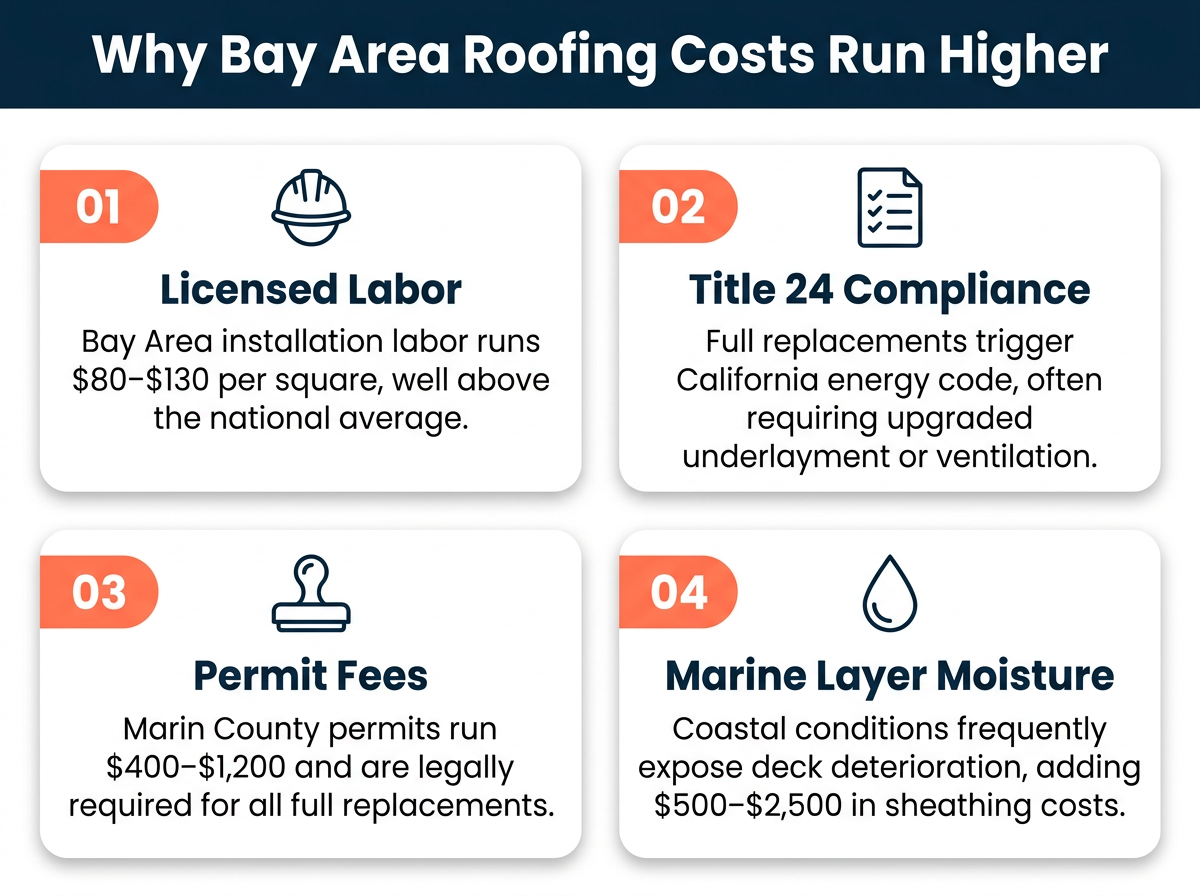
Four-panel infographic explaining why Bay Area roofing costs exceed national averages: licensed labor rates, Title 24 compliance, permit fees, and coastal marine layer moisture exposure.

Why California Roofing Costs Run Higher Than the National Average

Before you enter a figure into any roof replacement cost estimator for California, it helps to understand the four cost drivers that separate this market from the rest of the country. They compound — meaning each one adds to the next, not simply alongside it.

  Factor Detail
01 Licensed Labor Rates California requires CSLB-licensed contractors for all roofing work. Bay Area labor rates typically run $80–$130 per square (100 sq ft) for installation alone.
02 Title 24 & Code Compliance A full replacement triggers California’s Title 24 energy compliance review, which may require specific underlayment, ventilation upgrades, or cool-roof-rated materials.
03 Permit Fees Marin County cities charge permit fees based on project valuation. Expect $400–$1,200 for a standard residential replacement. Any estimate excluding permit costs understates the total investment.
04 Marine Layer & Moisture Coastal moisture demands thorough deck inspections. Discovering and replacing deteriorated sheathing is common in Marin County re-roofs, adding $500–$2,500 in material and labor.

“In Marin County, most residential roof replacements require a permit regardless of scope or material — a detail that affects your timeline, your financing, and whether your warranty is valid at close.”

New Roof Cost in the Bay Area: Ranges by Material

The single largest variable in a roofing estimate is material selection. The table below reflects installed Bay Area cost ranges — including labor, underlayment, flashing, disposal, and permit fees — for a standard 2,000 sq ft single-story home. Steep-pitch roofs, multi-story structures, and complex flashing work will push costs toward the upper end or beyond.
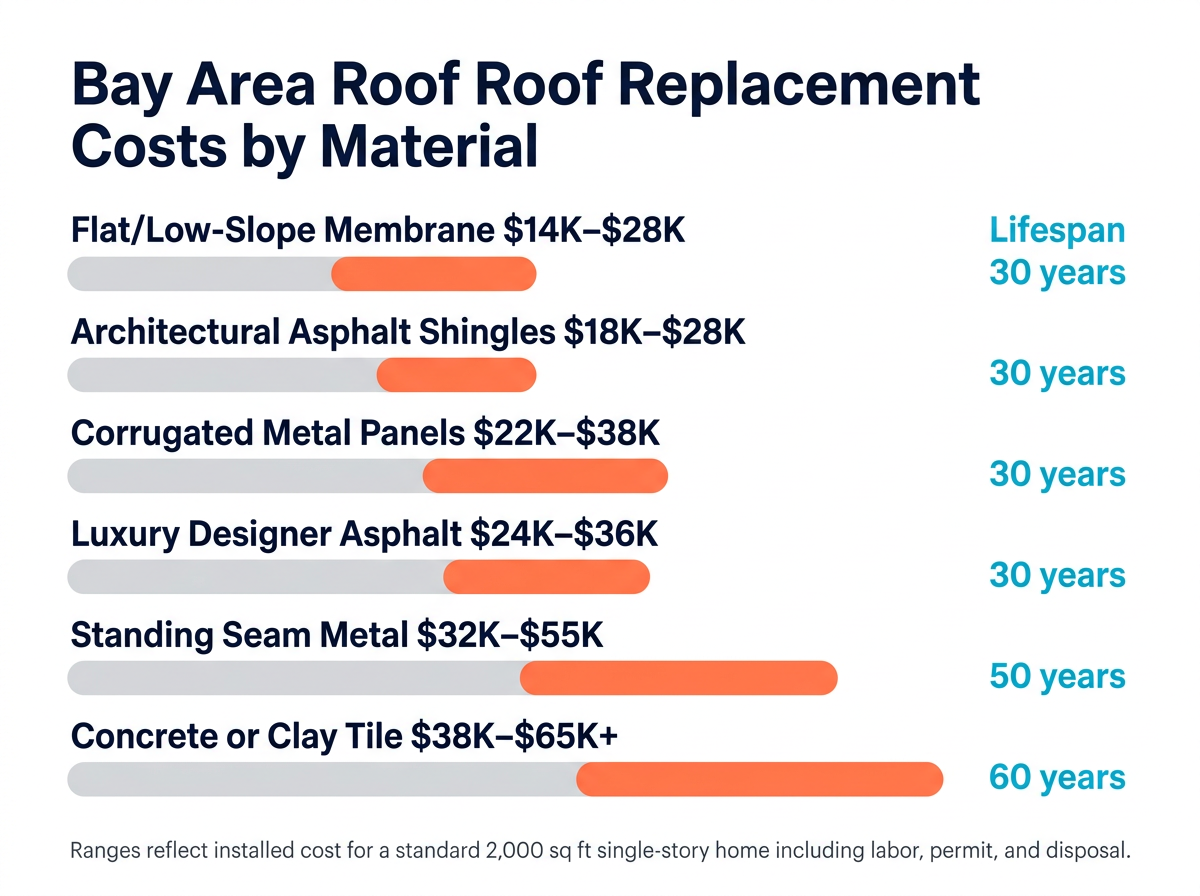
Horizontal bar chart showing Bay Area roof replacement cost ranges by material type, from flat membrane at $14,000–$28,000 up to concrete or clay tile at $38,000–$65,000+, with lifespan shown for each.

Material Bay Area Range Lifespan Notes
Architectural Asphalt Shingles $18,000 – $28,000 25–30 yrs Most common residential choice. Algae-resistant coatings recommended for Marin County moisture exposure.
Luxury / Designer Asphalt $24,000 – $36,000 30–35 yrs Higher profile, thicker construction. Better warranty terms, often preferred for higher-value homes.
Standing Seam Metal $32,000 – $55,000 40–60 yrs Excellent moisture resistance. Higher upfront cost often justified by longer warranty and lower lifecycle cost.
Corrugated Metal Panels $22,000 – $38,000 35–50 yrs Strong performer in coastal climates at a lower entry cost than standing seam.
Flat / Low-Slope Membrane (TPO/EPDM) $14,000 – $28,000 20–30 yrs Commercial and residential flat roofs. Cost varies significantly by square footage and membrane spec.
Concrete or Clay Tile $38,000 – $65,000+ 40–50 yrs Common in older Bay Area homes. Structural assessment required — many homes need deck reinforcement to support tile weight.

On Using a Roof Replacement Cost Estimator in California
Online estimators are useful for setting a budget range, but they cannot account for site-specific variables: roof pitch, existing deck condition, local permit fees, or the disposal cost of layered materials. Use an estimator to calibrate your expectations, then confirm the number with an on-site inspection before committing to scope or financing. Our free cost estimator is built specifically for California — and accounts for Bay Area labor rates and permit requirements that national tools miss.
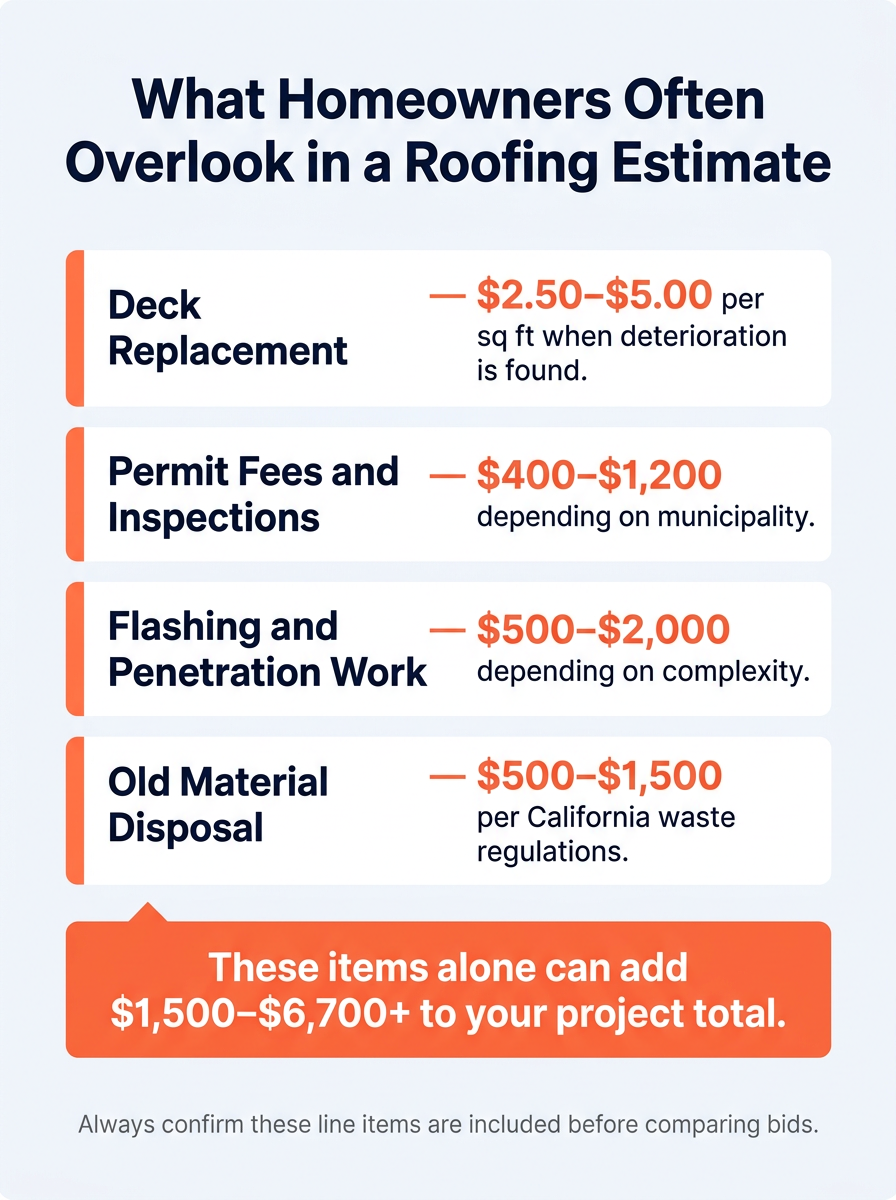
Invoice-style infographic showing four commonly overlooked roofing cost line items totaling a potential $1,500–$6,700+ addition: deck replacement, permits, flashing, and disposal.

What Affects the Final Number: Line Items Homeowners Often Overlook

The material cost is only one component of what you’ll actually pay. These are the line items that consistently surprise homeowners seeing a final estimate for the first time — and each is legitimate when the scope justifies it.

Deck Replacement and Structural Repair

Once the old roof is stripped, the condition of the underlying sheathing becomes visible. In Marin County, moisture infiltration over years of marine layer exposure frequently means partial or full deck board replacement. Budget $2.50–$5.00 per square foot for deck replacement when deterioration is found — and ask your contractor what they charge before the job starts so there are no surprises.

Permit Fees and Inspections

A full re-roof in San Rafael, Mill Valley, Novato, or any Marin County municipality requires a building permit. Inspection scheduling adds 1–3 days to your timeline (not weeks, when scheduled correctly). Any contractor telling you a permit isn’t required for a full replacement should be asked to show you the code citation. It is required.

Flashing and Penetration Work

Chimneys, skylights, vents, and valleys all require new or upgraded flashing on a full replacement. Failing to replace flashing on a new roof is the most common source of leak callbacks within the first two years. Expect $500–$2,000 in flashing costs depending on the number and complexity of penetrations.

Old Material Disposal

Removing and disposing of old roofing material runs $500–$1,500 depending on the number of existing layers, the material type, and local disposal rates. California has strict landfill requirements for construction debris that push disposal costs above the national average.

Roofing Costs in California: The Marin County Premium

Roofing costs in California run approximately 25–40% above national averages. Within the state, the San Francisco Bay Area — and Marin County specifically — sits at the higher end of California markets, driven by labor costs, regulatory complexity, and coastal climate requirements. A project that would cost $15,000 in Sacramento often runs $20,000–$28,000 for equivalent scope in Marin County.

This is not a reason to delay a necessary replacement. A failing or aging roof exposes Marin County homes — where property values average well above state medians — to water infiltration damage that compounds rapidly in a high-moisture coastal environment.

Why “Getting Three Bids” Can Mislead You in This Market

The standard homeowner advice to collect three bids assumes those bids are scoping the same project. In practice, a significant cost gap usually reflects differences in scope: one contractor includes full deck inspection and flashing replacement, another does not. Before comparing prices, confirm each bid includes the same line items — permit fees, deck inspection, flashing, underlayment spec, and warranty terms. Price differences after that comparison are meaningful. Price differences before it are noise.

How to Use a Roof Replacement Cost Estimator for California

A well-built California roof replacement cost estimator does three things a generic national tool cannot: it applies Bay Area labor rates rather than national averages, it factors in permit cost by county or municipality, and it accounts for California-specific material requirements like Title 24 cool-roof compliance.

To get an accurate estimate, you’ll need four inputs:

• Roof square footage — Measure your home’s footprint and add 10–15% for pitch factor. Your roofing contractor will measure precisely during an inspection, but a footprint estimate gets you close for budgeting.

• Roof pitch — Low-pitch (2:12–4:12), standard (4:12–6:12), and steep (7:12+) roofs have meaningfully different labor costs. Steep-pitch work adds $1,000–$3,500 to a standard estimate.

• Material preference — Use the table above to anchor your material selection against your budget and timeline goals.

• Location — Input your Marin County city or Bay Area zip code to apply local permit and labor rate calibration.

Estimator vs. On-Site Inspection
Use the estimator to establish your budget range and evaluate financing options. Use the on-site inspection to confirm scope, identify hidden conditions, and lock in a final number. The estimator is a planning tool — the inspection is the contract foundation. We recommend doing both in sequence before committing to any project.

Views: 4

Search ideas & guides for your remodel

Sign up for our newsletter

Subscribe to receive the latest blog posts to your inbox every week.

Newsletter

Consent

By subscribing you agree to with our Privacy Policy.

Recent Posts

  • All Posts
  • Commercial Roofing
  • Home Restoration
  • Roof Inspection
  • Roof Installation
  • Roof Repair
  • Roof Replacement
Aerial view of a hillside home with a dark asphalt shingle roof, solar panels, and wood decks surrounded by trees.

Insurance and Roof Claims Guide

Five-step infographic for choosing a roofing contractor in Marin County: verify the license, confirm insurance, check local experience, compare itemized estimates, and review ratings and warranty terms.

How to Choose a Roofing Contractor in Marin County

Infographic of a Marin County home mid-reroof beside the five roofing permit steps: confirm jurisdiction, submit application, plan review, roof work, and final inspection, with possible coastal, septic, and energy code reviews.

Roofing Permits in Marin County: What Homeowners Need to Know

Attic cross-section showing cool air entering soffit vents, passing through baffles over insulation, and warm air exiting a ridge vent.

Roof Ventilation & Attic Guide

Comparison chart of TPO, EPDM, and asphalt shingle roofing showing lifespan, energy reflectivity, and cost differences for flat vs. sloped roofs.

TPO & Flat Roofs in the Bay Area: Cost, Lifespan, and Repair vs. Replace

Map diagram showing an atmospheric river moisture band traveling from the tropical Pacific Ocean to the San Francisco Bay Area coastline.

How Atmospheric Rivers Damage Bay Area Roofs — What Homeowners Should Watch For

Diagram showing how Marin's marine layer fog causes granule loss, algae growth, and trapped attic moisture that shorten asphalt shingle roof life from 25–30 years to 10–15 years.

Why Asphalt Shingle Roofs Fail Early in Marin’s Marine-Layer Climate

Three-stage roof repair process diagram showing emergency repair, temporary repair, and permanent repair for Marin County roof leaks.

Roof Leak Triage in Marin: Emergency vs. Temporary vs. Permanent Repair

Hero infographic comparing overlay versus full tear-off roof replacement, showing shingle layers, deck inspection status, and cost differences.

The Re-Roofing Process: What to Expect, Overlay vs. Tear-Off

Share this post
  • Roof Installation
Picture of Michael Machkovsky
Michael Machkovsky
Michael serves as CEO at Marina Bay Roofing and brings seven years of hands-on roofing and construction experience to the team. Born and raised in the Bay Area, he’s dedicated to helping homeowners feel confident in the work protecting their homes. When he’s not on the job, you’ll find him spending time with his 7-year-old son.

Blog

Related posts

Lorem ipsum dolor sit amet, consectetur adipiscing elit.

Aerial view of a hillside home with a dark asphalt shingle roof, solar panels, and wood decks surrounded by trees.
Roof Inspection
Michael Machkovsky

Insurance and Roof Claims Guide

Filing a roof insurance claim is one of the most

Read More »
October 27, 2026
Five-step infographic for choosing a roofing contractor in Marin County: verify the license, confirm insurance, check local experience, compare itemized estimates, and review ratings and warranty terms.
Roof Installation
Michael Machkovsky

How to Choose a Roofing Contractor in Marin County

Marin County homeowners eventually face the same question: how do

Read More »
October 26, 2026
Infographic of a Marin County home mid-reroof beside the five roofing permit steps: confirm jurisdiction, submit application, plan review, roof work, and final inspection, with possible coastal, septic, and energy code reviews.
Roof Installation
Michael Machkovsky

Roofing Permits in Marin County: What Homeowners Need to Know

Getting a permit in Marin County follows a process that

Read More »
October 26, 2026
View All

Sign up for our newsletter

Join Our Community for Updates and roof renovation Insights

Newsletter

Consent

Ready to imagine your own project?

Request Your Personalized Consultation

and let’s talk about your space, your ideas, and how we can bring them to life.

Quick links
  • Home
  • About
  • Roofing Services
  • Commercial Roofing
  • Materials
  • Gallery
  • FAQ
  • Blog
  • contact
Services
  • Roof Inspection
  • Roof Installation
  • Roof Repair
  • Roof Replacement
  • Skylight Installation
Contact Us

Locations:
4411 Geary Blvd #301
San Francisco, CA 94118
Phone: (628) 233-8140

710 C Street Suite 208
San Rafael, CA 94901
Phone: (415) 860-7257

Email: [email protected]

License & Certifications

State Contractor License #1133789

Fully Licensed • Bonded • Insured

Find Us on Map

Proudly serving our community with honesty, craftsmanship, and care.

© 2026Marina Bay Roofing Inc.

Privacy Policy

Terms of Service

Facebook-f Yelp Instagram