Skip to content

Get an Instant Roof Cost Estimate →

Need a new roof or repairs?

  • Call (628) 233-8140
  • Home
  • About
    • Who We Are
    • Why Choose Us?
  • Roofing Services
    • Roof Inspection
    • Roof Installation
    • Roof Repair
    • Roof Replacement
    • Skylight Installation
  • Commercial
    • Commercial Roofing Contractors
    • Commercial Roof Installation
    • Commercial Roof Repairs
  • Materials
    • Asphalt Shingles
    • Metal Roof Panels
    • Clay & Concrete Tiles
    • Skylight Installation
    • TPO Flat Roof
    • Flat Roof Contractors
    • Flat Roof Repair
    • Flat Roof Installers
  • Service Area

    San Francisco Bay Area

    • Alamo
    • Belmont
    • Berkeley
    • Burlingame
    • Danville
    • Dublin
    • Fremont
    • Los Gatos
    • Millbrae
    • Milpitas
    • Oakland
    • Orinda
    • Palo Alto
    • Piedmont
    • Pleasanton
    • Pleasant Hill
    • Redwood City
    • Richmond
    • San Bruno
    • San Carlos
    • San Francisco
    • San Jose
    • San Leandro
    • San Lorenzo
    • San Mateo
    • San Pablo
    • San Ramon
    • South San Francisco
    • Walnut Creek

    Marin County

    • Belvedere
    • Corte Madera
    • Fairfax
    • Kentfield
    • Larkspur
    • Mill Valley
    • Novato
    • Ross
    • San Anselmo
    • San Rafael
    • Sausalito
    • Tiburon
    • Tamalpais-Homestead Valley
  • Roof Cost Calculator
  • Gallery
  • FAQs
  • Blog
Contact
  • Roof Installation

Why Asphalt Shingle Roofs Fail Early in Marin’s Marine-Layer Climate

Michael Machkovsky

  • Roof Installation
Diagram showing how Marin's marine layer fog causes granule loss, algae growth, and trapped attic moisture that shorten asphalt shingle roof life from 25–30 years to 10–15 years.

A shingle roof rated for twenty-five years shouldn’t need attention at year twelve. But across Marin County, that’s exactly what many homeowners find: granule loss, curling edges, and algae streaks on a rooftop that’s barely into middle age. The culprit usually isn’t poor installation, bad luck, or one stretch of extreme weather — it’s Marin’s marine layer, and the daily moisture cycle it puts every asphalt shingle roof through, year after year.

This guide explains why asphalt shingle roofs fail early in Marin’s marine-layer climate, what that failure actually looks like, and what roofing materials and maintenance choices help a roof perform closer to its full life expectancy despite the coastal weather found in this part of California.

Quick Answers to FAQs

Why do asphalt shingle roofs fail early in Marin specifically?

Marin’s marine layer keeps roofs damp far more often than drier climates, accelerating granule loss, algae growth, and general shingle deterioration well ahead of a typical rated lifespan.

How many years should an asphalt shingle roof last in Marin's marine layer climate?

Shingles rated for twenty-five to thirty years elsewhere often show significant wear for ten to fifteen years in Marin, depending on roof pitch, ventilation, and shade exposure — a gap not typically seen in drier parts of California.

Are architectural shingles worth the extra cost in a marine layer climate?

Generally yes. Architectural shingles resist moisture-related granule loss and algae better than standard tab shingles, which can meaningfully extend roof life in coastal areas like Marin.

Does algae on my roof mean it needs to be replaced?

Not necessarily. Algae alone is often a maintenance issue, but if it’s been present for a long time, it can trap moisture and contribute to shingle damage worth having a professional roof inspection assess.

Is metal roofing a better option than asphalt shingles in Marin?

Metal roofing holds up better against marine layer moisture and algae over the long run, though asphalt shingles remain more affordable upfront, so the right choice depends on budget and how long you plan to stay in the home.

Why Shingles Fail Early in Marin

Marin’s marine layer keeps roofs damp far more often than drier inland climates, and that near-constant moisture accelerates granule loss, algae growth, and shingle deterioration well ahead of a shingle’s rated lifespan. Asphalt shingles are especially vulnerable because their protective granules and asphalt base both degrade faster under repeated wetting and drying. Poor attic ventilation and shaded roof sections make the problem worse, while better roofing materials and maintenance can meaningfully extend a roof’s life in this climate.

What Is Marin’s Marine Layer, and Why Does It Matter for Roofs?

The marine layer is the low coastal fog and moist air that regularly rolls in off the Pacific and settles over Marin County, especially overnight and in the early morning.

Unlike a typical rainstorm that comes and goes, marine layer moisture can sit on a roof surface for hours nearly every day, keeping shingles damp long after inland roofs have dried out completely.

For roofs, that daily moisture cycle matters more than most homeowners realize. Asphalt shingles are engineered to handle rain and typical weather, but they’re not designed for sustained, repeated dampness day after day, year-round. Over time, that difference shows up as measurably shorter shingle life compared to the same product installed in a drier, sunnier part of California.
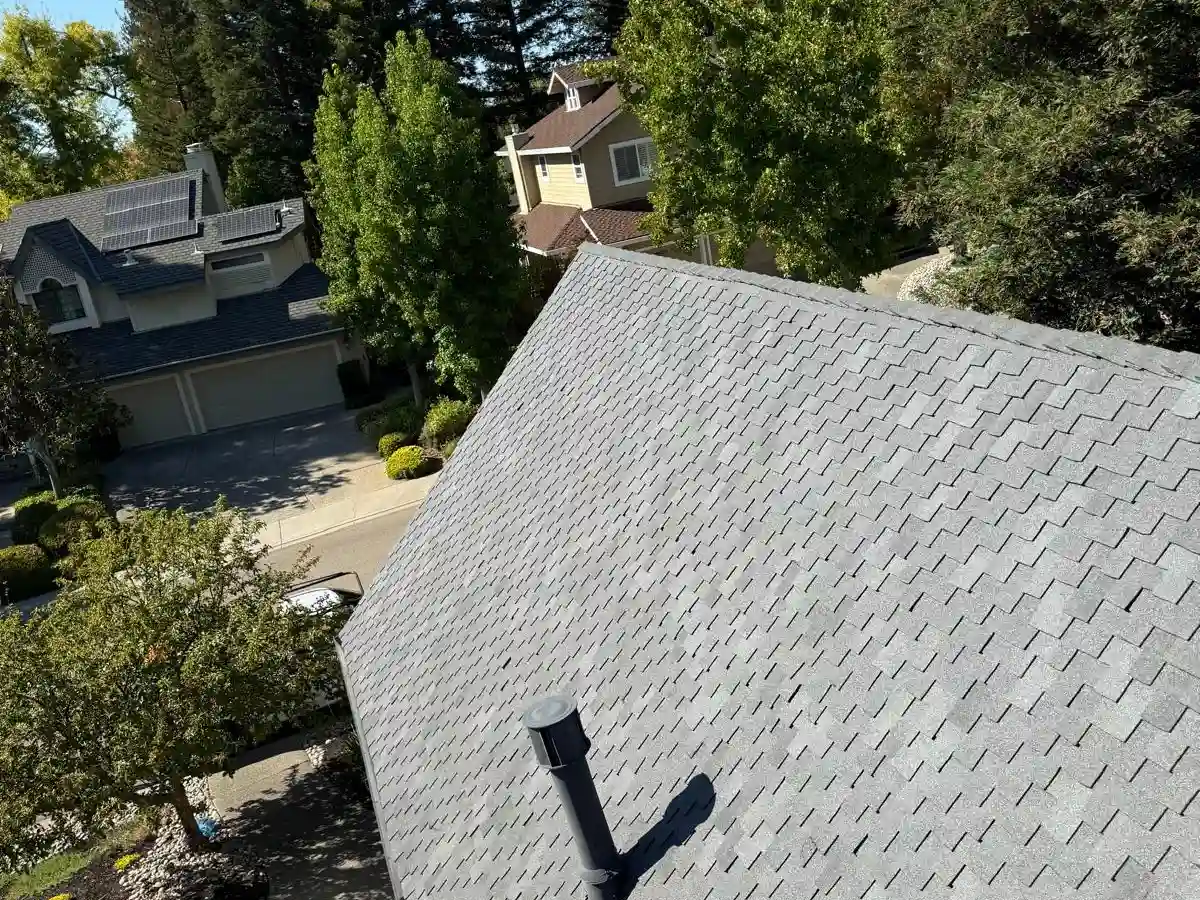
Aerial view of a shingle roof surrounded by tree canopy, showing the kind of shade exposure that contributes to algae growth in marine-layer climates.

How Marine Layer Moisture Causes Premature Shingle Failure

Premature shingle failure in Marin almost always traces back to moisture exposure, working through a few specific mechanisms.

Granule Loss From Constant Moisture

Granule loss is one of the earliest and most visible signs of marine layer roof wear. The granules embedded in asphalt shingles protect the underlying asphalt from UV exposure and physical wear, but repeated wetting and drying cycles loosen them faster than in a consistently dry climate. Once granule loss becomes significant, the exposed asphalt underneath degrades much faster, accelerating shingle failure across the whole roof.

Algae Growth on Shaded, Damp Roofs

Algae is a near-constant presence on marine-layer-exposed roofs, particularly on north-facing slopes and sections shaded by trees. Algae thrives in the moisture the marine layer provides, and while it’s often mistaken for simple discoloration, sustained algae growth traps additional moisture against the shingle surface and contributes to long-term roof damage. Algae-resistant shingles exist specifically to address this issue in coastal climates like Marin’s.

Attic Ventilation and Its Role in Shingle Roof Lifespan

Attic ventilation plays a bigger role in shingle roof lifespan than many homeowners expect. A poorly ventilated attic traps heat and humidity underneath the roof deck, which works against shingles from below at the same time marine layer moisture works against them from above. Proper attic ventilation lets built-up moisture escape rather than condensing under the roof, which meaningfully improves roof performance over the life of the shingles.
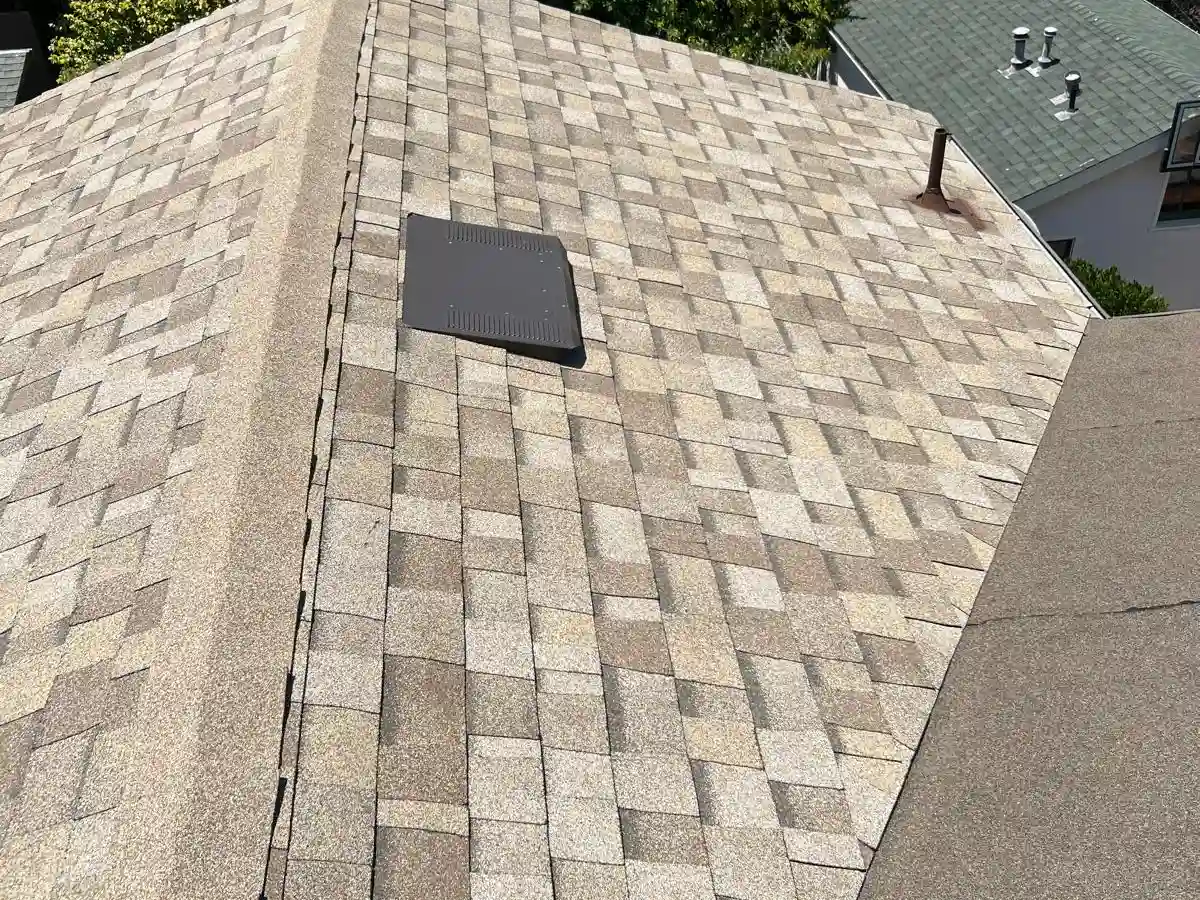
Close-up of asphalt shingle texture and a roof vent, illustrating the attic ventilation components that affect shingle lifespan in coastal climates.

Common Reasons Asphalt Shingle Roofs Fail Early

Beyond moisture and ventilation, a handful of common reasons show up repeatedly in early roof failure across Marin.

Poor Roof Pitch and Water Pooling

Roof pitch affects how quickly water and marine layer moisture drain off a roof surface. A low roof pitch, or a flat roof section on an otherwise sloped home, allows moisture to pool rather than run off, which accelerates granule loss and shingle deterioration in exactly the spots that stay wet longest.

Natural Wear vs. Premature Roof Failure

It’s worth distinguishing ordinary natural wear from true premature roof failure. Every shingle roof ages and loses some granules over time; that’s expected. Premature failure means a roof is showing significant damage years before its rated life expectancy, and in Marin, that gap is almost always tied back to marine layer exposure rather than a single dramatic event.

Signs of Shingle Damage to Watch For

Common signs of shingle damage include visible granule loss in gutters, curling or cupping shingle edges, dark streaking from algae, cracked or brittle shingles, and soft spots on the roof deck underneath. Catching these signs early, through regular roof inspections, gives homeowners a chance to address shingle damage before it becomes full roof failure.
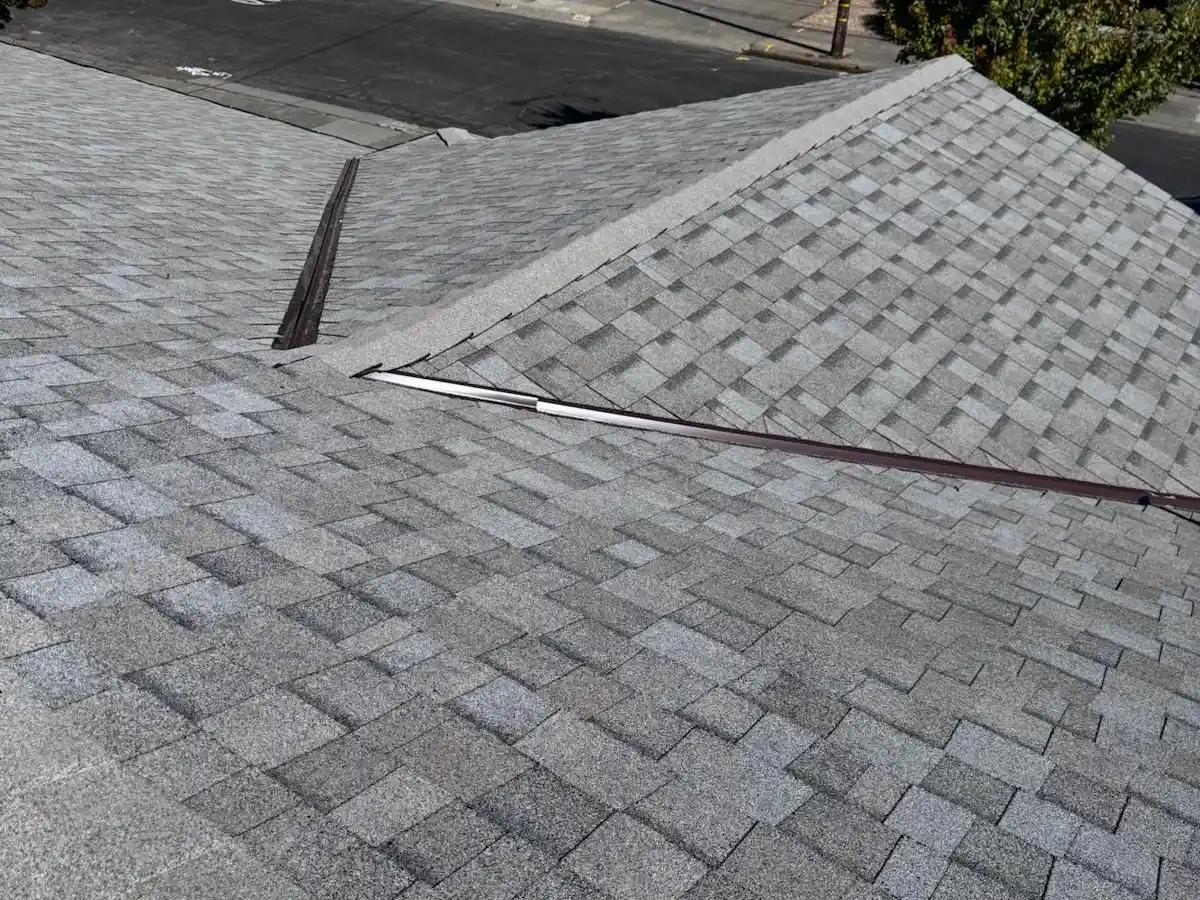
Close-up of an asphalt shingle roof ridge cap and flashing, showing the wear patterns homeowners should watch for in Marin's coastal climate.

Choosing the Right Roofing Materials for Coastal Areas

Not all roofing materials perform equally well in Marin’s marine layer climate, which makes material selection one of the most important decisions for modern homes in coastal areas of California.

Architectural Shingles vs. Traditional Tab Shingles

Architectural shingles, sometimes called dimensional shingles, are generally more durable than standard three-tab shingles in coastal climates. Their thicker, layered construction resists curling and granule loss better than older-style tab shingles, making architectural shingles a common upgrade recommendation for marine-layer-exposed homes. Quality shingles with strong algae-resistant coatings offer additional protection against the moisture and algae growth common in this climate.

Metal Roofing and Other Alternatives to Asphalt Roofs

For homeowners who’ve experienced repeated shingle failure, metal roofing is worth considering as an alternative to asphalt roofs entirely, especially in the foggiest coastal pockets of California. Metal roofing sheds moisture more effectively and isn’t vulnerable to granule loss or algae in the same way, though it comes at a higher upfront cost than asphalt shingles.

Shingle Warranties and Life Expectancy in Marin’s Climate

Shingle warranties are typically written based on national averages, not Marin’s specific marine layer conditions, so a shingle rated for twenty-five to thirty years elsewhere may not reach that life expectancy here. Homes just a short drive inland, in warmer, drier parts of California, often see shingles last several more years than the same product on a marine-layer-exposed roof, since they face less daily weather-driven moisture. Reading the fine print on shingle warranties, including any exclusions related to algae or moisture damage, helps set realistic expectations before installation.
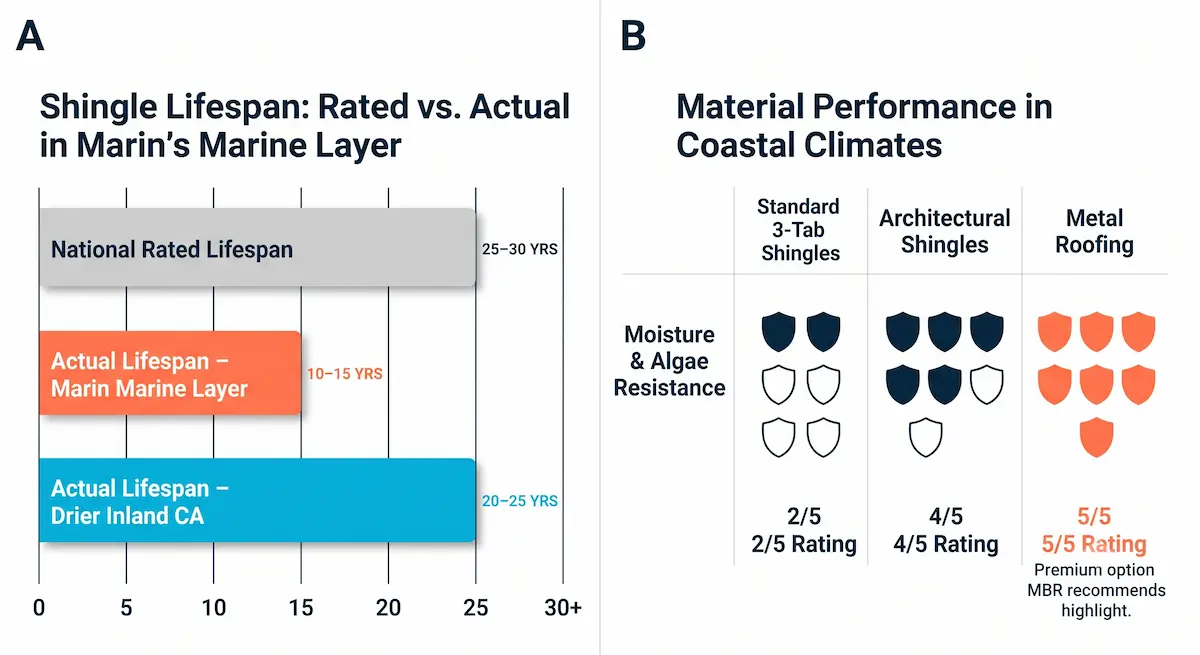
Bar chart comparing asphalt shingle lifespan in Marin's marine layer versus rated and drier-climate lifespans, alongside a material comparison of 3-tab shingles, architectural shingles, and metal roofing durability.

How to Extend the Life of an Asphalt Shingle Roof

A few maintenance habits meaningfully extend longevity despite Marin’s climate over the years: keep gutters clear so water drains properly, trim back trees that shade and dampen roof sections, address granule loss and shingle damage early rather than waiting, and confirm attic ventilation is adequate during any roof maintenance visit. None of these steps eliminate marine layer exposure, but together they slow how fast shingles age.

When to Schedule a Professional Roof Inspection

A professional roof inspection is worth scheduling at the first sign of granule loss, algae growth, or curling shingles, rather than waiting for an active leak. In Marin’s climate, roofs benefit from more frequent inspections than the same home might need in a drier part of California, simply because marine layer wear progresses steadily over the years rather than all at once.

Key Takeaways

  • Marin’s marine layer keeps roofs damp on a near-daily basis, which accelerates granule loss, algae growth, and premature shingle failure — more so than in drier inland parts of California.
  • Attic ventilation and roof pitch both influence how much moisture-related damage a shingle roof experiences over time.
  • Architectural shingles and algae-resistant products generally outperform standard tab shingles in Marin’s climate.
  • Shingle warranties are based on national averages and often don’t reflect the real-world life expectancy of a roof exposed to marine layer conditions.
  • Regular roof inspections catch granule loss and early shingle damage before it becomes full roof failure.

Get a Free Roof Assessment

If your roof is showing granule loss, algae, or curling shingles ahead of schedule, a free roof assessment can confirm whether you’re looking at natural wear or true premature failure — and what roofing materials make sense for your home’s specific exposure to Marin’s marine layer.

Views: 4

Search ideas & guides for your remodel

Sign up for our newsletter

Subscribe to receive the latest blog posts to your inbox every week.

Newsletter

Consent

By subscribing you agree to with our Privacy Policy.

Recent Posts

  • All Posts
  • Commercial Roofing
  • Home Restoration
  • Roof Inspection
  • Roof Installation
  • Roof Repair
  • Roof Replacement
Aerial view of a hillside home with a dark asphalt shingle roof, solar panels, and wood decks surrounded by trees.

Insurance and Roof Claims Guide

Five-step infographic for choosing a roofing contractor in Marin County: verify the license, confirm insurance, check local experience, compare itemized estimates, and review ratings and warranty terms.

How to Choose a Roofing Contractor in Marin County

Infographic of a Marin County home mid-reroof beside the five roofing permit steps: confirm jurisdiction, submit application, plan review, roof work, and final inspection, with possible coastal, septic, and energy code reviews.

Roofing Permits in Marin County: What Homeowners Need to Know

Attic cross-section showing cool air entering soffit vents, passing through baffles over insulation, and warm air exiting a ridge vent.

Roof Ventilation & Attic Guide

Comparison chart of TPO, EPDM, and asphalt shingle roofing showing lifespan, energy reflectivity, and cost differences for flat vs. sloped roofs.

TPO & Flat Roofs in the Bay Area: Cost, Lifespan, and Repair vs. Replace

Map diagram showing an atmospheric river moisture band traveling from the tropical Pacific Ocean to the San Francisco Bay Area coastline.

How Atmospheric Rivers Damage Bay Area Roofs — What Homeowners Should Watch For

Diagram showing how Marin's marine layer fog causes granule loss, algae growth, and trapped attic moisture that shorten asphalt shingle roof life from 25–30 years to 10–15 years.

Why Asphalt Shingle Roofs Fail Early in Marin’s Marine-Layer Climate

Three-stage roof repair process diagram showing emergency repair, temporary repair, and permanent repair for Marin County roof leaks.

Roof Leak Triage in Marin: Emergency vs. Temporary vs. Permanent Repair

Hero infographic comparing overlay versus full tear-off roof replacement, showing shingle layers, deck inspection status, and cost differences.

The Re-Roofing Process: What to Expect, Overlay vs. Tear-Off

Share this post
  • Roof Installation
Picture of Michael Machkovsky
Michael Machkovsky
Michael serves as CEO at Marina Bay Roofing and brings seven years of hands-on roofing and construction experience to the team. Born and raised in the Bay Area, he’s dedicated to helping homeowners feel confident in the work protecting their homes. When he’s not on the job, you’ll find him spending time with his 7-year-old son.

Blog

Related posts

Lorem ipsum dolor sit amet, consectetur adipiscing elit.

Aerial view of a hillside home with a dark asphalt shingle roof, solar panels, and wood decks surrounded by trees.
Roof Inspection
Michael Machkovsky

Insurance and Roof Claims Guide

Filing a roof insurance claim is one of the most

Read More »
October 27, 2026
Five-step infographic for choosing a roofing contractor in Marin County: verify the license, confirm insurance, check local experience, compare itemized estimates, and review ratings and warranty terms.
Roof Installation
Michael Machkovsky

How to Choose a Roofing Contractor in Marin County

Marin County homeowners eventually face the same question: how do

Read More »
October 26, 2026
Infographic of a Marin County home mid-reroof beside the five roofing permit steps: confirm jurisdiction, submit application, plan review, roof work, and final inspection, with possible coastal, septic, and energy code reviews.
Roof Installation
Michael Machkovsky

Roofing Permits in Marin County: What Homeowners Need to Know

Getting a permit in Marin County follows a process that

Read More »
October 26, 2026
View All

Sign up for our newsletter

Join Our Community for Updates and roof renovation Insights

Newsletter

Consent

Ready to imagine your own project?

Request Your Personalized Consultation

and let’s talk about your space, your ideas, and how we can bring them to life.

Quick links
  • Home
  • About
  • Roofing Services
  • Commercial Roofing
  • Materials
  • Gallery
  • FAQ
  • Blog
  • contact
Services
  • Roof Inspection
  • Roof Installation
  • Roof Repair
  • Roof Replacement
  • Skylight Installation
Contact Us

Locations:
4411 Geary Blvd #301
San Francisco, CA 94118
Phone: (628) 233-8140

710 C Street Suite 208
San Rafael, CA 94901
Phone: (415) 860-7257

Email: [email protected]

License & Certifications

State Contractor License #1133789

Fully Licensed • Bonded • Insured

Find Us on Map

Proudly serving our community with honesty, craftsmanship, and care.

© 2026Marina Bay Roofing Inc.

Privacy Policy

Terms of Service

Facebook-f Yelp Instagram