Skip to content

Get an Instant Roof Cost Estimate →

Need a new roof or repairs?

  • Call (628) 233-8140
  • Home
  • About
    • Who We Are
    • Why Choose Us?
  • Roofing Services
    • Roof Inspection
    • Roof Installation
    • Roof Repair
    • Roof Replacement
    • Skylight Installation
  • Commercial
    • Commercial Roofing Contractors
    • Commercial Roof Installation
    • Commercial Roof Repairs
  • Materials
    • Asphalt Shingles
    • Metal Roof Panels
    • Clay & Concrete Tiles
    • Skylight Installation
    • TPO Flat Roof
    • Flat Roof Contractors
    • Flat Roof Repair
    • Flat Roof Installers
  • Service Area

    San Francisco Bay Area

    • Alamo
    • Belmont
    • Berkeley
    • Burlingame
    • Danville
    • Dublin
    • Fremont
    • Los Gatos
    • Millbrae
    • Milpitas
    • Oakland
    • Orinda
    • Palo Alto
    • Piedmont
    • Pleasanton
    • Pleasant Hill
    • Redwood City
    • Richmond
    • San Bruno
    • San Carlos
    • San Francisco
    • San Jose
    • San Leandro
    • San Lorenzo
    • San Mateo
    • San Pablo
    • San Ramon
    • South San Francisco
    • Walnut Creek

    Marin County

    • Belvedere
    • Corte Madera
    • Fairfax
    • Kentfield
    • Larkspur
    • Mill Valley
    • Novato
    • Ross
    • San Anselmo
    • San Rafael
    • Sausalito
    • Tiburon
    • Tamalpais-Homestead Valley
  • Roof Cost Calculator
  • Gallery
  • FAQs
  • Blog
Contact
  • Roof Installation

How to Choose a Roofing Contractor in the San Francisco Bay Area

Michael Machkovsky

  • Roof Installation
How to choose a roofing contractor in the San Francisco Bay Area — key criteria including C-39 licensing, GAF Master Elite certification, WUI compliance, and permit requirements

If you’re searching for the best roofing companies in the Bay Area, you’ve already done the hard part: you recognize that not every contractor is qualified to work on your home. The Bay Area — and Marin County in particular — presents conditions that punish shortcuts: coastal moisture, marine layer exposure, Wildland-Urban Interface (WUI) fire zone requirements, and some of the most stringent local building departments in California. Choosing the wrong contractor isn’t just a financial risk. It’s a structural one.

This guide walks you through exactly what to verify before signing anything.

Quick Answers to FAQs

What license does a roofing contractor need to legally work in California?

A roofing contractor in California must hold an active C-39 Roofing Contractor license issued by the California Contractors State License Board (CSLB). This license is required for any roofing job exceeding $500 in labor and materials. You can verify any contractor’s license status, bond, and insurance at cslb.ca.gov before signing anything.

What is a GAF Master Elite contractor and why does it matter?

GAF Master Elite is a designation awarded to fewer than 3% of roofing contractors in the United States. To qualify, a contractor must hold an active state license, maintain adequate insurance, and meet ongoing training requirements. The practical significance is warranty coverage: a GAF Master Elite contractor can offer the Golden Pledge Warranty, which covers both workmanship and materials and is backed by GAF directly, not just the installer.

What is a WUI zone and how does it affect my roofing project?

WUI stands for Wildland-Urban Interface — a designation applied to areas where residential development meets or intermingles with undeveloped wildland vegetation. In Marin County, many hillside neighborhoods in Mill Valley, Fairfax, San Anselmo, Novato, and unincorporated areas carry WUI designation. WUI status triggers specific California Building Code requirements for roofing, including mandatory Class A fire-rated assemblies, specific underlayment specs, and ember-resistant ridge and eave closure details. Any contractor working on a WUI-designated property must be familiar with these requirements and able to pull compliant permits.

Do I need a permit for a roof replacement in the Bay Area?

In most Bay Area and Marin County jurisdictions, a full roof replacement requires a building permit. Inspections are required at specific stages of the project. Skipping permits creates three serious risks: your insurance company may deny a future claim on an unpermitted roof, unpermitted work must be disclosed during resale and can complicate a transaction, and a non-permitted installation may not meet current California Building Code requirements, including fire ratings in WUI zones.

How do coastal and marine layer conditions affect roofing in Marin County?

The persistent moisture from the marine layer accelerates deterioration of improperly installed flashing, underlayment, and low-slope transitions. Properties in Sausalito, Tiburon, Belvedere, Corte Madera, and along the Marin waterfront are particularly exposed. A contractor working in these conditions should be able to speak specifically to moisture management — including flashing detailing, underlayment product selection, and how they handle penetrations — not just recommend a standard asphalt shingle product.

What should a professional roofing estimate include?

A complete roofing estimate should itemize the full scope of work (including tear-off, underlayment, flashing replacement, and penetration details), specify materials by manufacturer and product line, state warranty terms separately for workmanship and materials, confirm permits and inspections are included, provide a project timeline, and outline a payment schedule tied to milestones. An estimate that offers only a lump-sum figure with no material specification or permit mention is not a professional document.

How do I evaluate roofing contractor reviews effectively?

Look for reviews that reference specific project details — the crew lead by name, the permit and inspection process, communication quality, and post-project follow-up. These signals indicate an accountable, process-oriented contractor. Generic five-star reviews without any project detail provide no useful information. Also scrutinize review patterns: reviews clustered in a short window or written in identical language are worth questioning.

What questions should I ask roofing references?

When calling references, ask whether the project came in on schedule and what caused any delays, whether the final scope matched the original estimate, how the contractor handled the permit and inspection process, and whether the homeowner would hire them again. Request references from projects completed in the past 18 months that are similar in type and scope to yours. One reference who answers these questions in detail is more useful than a long list of names.

What is the difference between a workmanship warranty and a manufacturer warranty?

A workmanship warranty is provided by the contractor and covers defects in the installation itself — improper flashing, inadequate fastening, poor sealing. A manufacturer warranty covers defects in the roofing materials. These are two separate coverage instruments with different durations and terms. Premium manufacturer programs, such as the GAF Golden Pledge Warranty, bundle both into a single coverage document backed by the manufacturer, which provides stronger protection than a contractor-only workmanship warranty.

How do I verify a contractor's insurance before hiring them?

Ask the contractor to provide a Certificate of Insurance naming you as an additional insured for the duration of the project. The certificate should confirm general liability coverage and workers’ compensation insurance. Contact the issuing insurance agency directly to verify the policy is active and has not lapsed. A contractor who carries only general liability without workers’ compensation creates personal liability exposure for the homeowner if a worker is injured on your property.

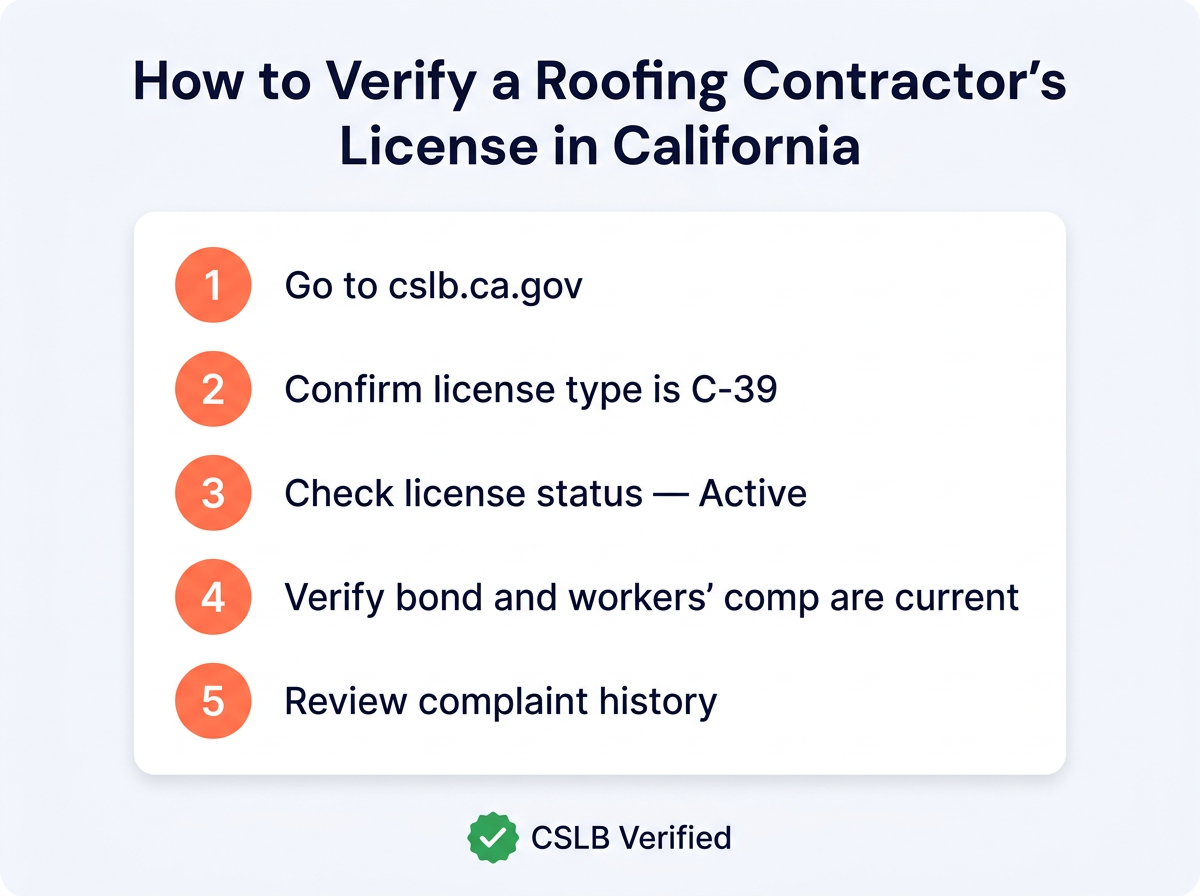
Five-step infographic showing how to verify a roofing contractor's C-39 license and insurance on the CSLB website before signing a contract in California

The Licensing Baseline: Non-Negotiable in California

Every roofing contractor working in California must hold an active C-39 Roofing Contractor license issued by the California Contractors State License Board (CSLB). This is not a nice-to-have — it’s the legal requirement for any roofing job exceeding $500 in labor and materials.

Before you contact a single contractor, verify their license:

  1. Go to www.cslb.ca.gov and use the License Check tool.
  2. Confirm the license type is C-39 (Roofing), not a general B license being used to cover roofing work.
  3. Check the license status (active, not suspended or expired).
  4. Confirm the bond and workers’ compensation insurance are both current.
  5. Check the complaint history — any filed complaints appear in the record.

A contractor without an active C-39 cannot legally pull permits in California. If they’re offering to skip permits, that’s your signal to move on.

What to ask directly: “What is your CSLB license number, and can I verify it?” Any reputable contractor will answer without hesitation.
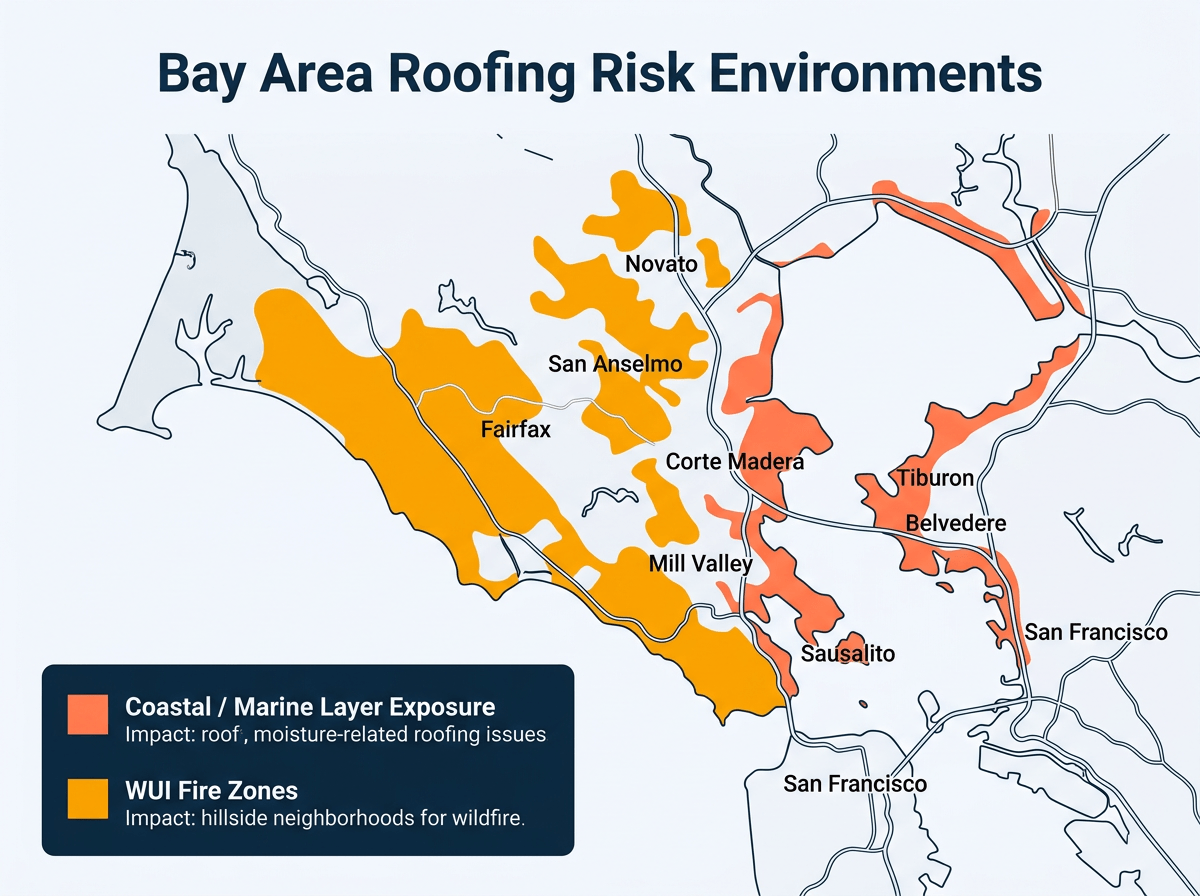
Illustrated diagram of Marin County roofing risk zones — coastal and marine layer exposure areas versus WUI Wildland-Urban Interface fire zone designations affecting roofing code requirements

Bay Area-Specific Criteria: Coastal and WUI Environments

This is where Bay Area homeowners need to apply extra scrutiny. Roofing in Marin County and the greater Bay Area is not equivalent to roofing in Sacramento or the Central Valley.

Coastal and Marine Layer Exposure

Properties in Marin County, Tiburon, Sausalito, Belvedere, Corte Madera, and along the San Francisco waterfront deal with persistent moisture from the marine layer. That moisture accelerates deterioration of improperly installed flashing, flashings at penetrations, and low-slope transitions. Ask contractors directly:

  • “Have you worked on homes with persistent coastal moisture exposure?”
  • “How do you handle flashing and underlayment spec for coastal conditions?”
  • “Which materials do you recommend for high-moisture environments, and why?”

A contractor who gives you a generic answer about asphalt shingles without addressing moisture management is not thinking about your specific roof’s long-term performance.

WUI (Wildland-Urban Interface) Requirements

A significant portion of Marin County — including parts of Mill Valley, Fairfax, San Anselmo, Novato, and the unincorporated hillsides — falls within designated Wildland-Urban Interface zones. WUI designation triggers specific roofing requirements under the California Building Code, including:

  • Class A fire-rated roofing assemblies (required in most WUI zones)
  • Specific underlayment requirements
  • Ridge cap and eave closure specs designed to prevent ember intrusion
  • Some jurisdictions require fire-resistant assemblies even for repair work above a certain scope

If your property is in a WUI zone, your contractor must demonstrate familiarity with the specific WUI requirements that apply to your parcel. Confirm they have pulled WUI-compliant permits in your county. Request documentation.

If a contractor is not familiar with WUI requirements in Marin County, do not hire them for a WUI-affected property. The fire risk is too serious, and a non-compliant installation may create liability issues if you need to file an insurance claim.

Evaluating Bay Area Roofers: Reviews, References, and Red Flags

When reading bay area roofers reviews, the patterns you’re looking for go beyond star ratings.

What Strong Reviews Actually Signal

  • Specific mention of the project manager or crew lead — indicates a consistent, accountable team
  • Reference to the permit and inspection process — signals the contractor does not skip steps
  • Comment on communication quality — “they told me what was happening at every stage” is a meaningful differentiator
  • Mention of post-project follow-up — especially relevant for larger replacement projects

What to Ignore

  • Generic 5-star reviews without detail (“Great job, highly recommend”) — these provide no useful signal
  • Reviews that all use identical language — may indicate coached or manufactured reviews
  • Review dates clustered unnaturally — a contractor who receives 40 reviews in one week after years of inactivity warrants scrutiny

Reference Calls: What to Ask

Request references from projects completed in the past 18 months, specifically for the service type you’re considering. For a roof replacement, ask:

  • “Did the project come in on schedule? If not, what caused the delay?”
  • “Were there any surprises in the final cost compared to the estimate?”
  • “How did they handle the permit and inspection process?”
  • “Would you hire them again?”

One reference who answers these questions in detail is worth more than ten generic 5-star reviews.

Evaluating Estimates: What a Professional Quote Looks Like

A professional roofing estimate from any best-rated roofing company near me search should include — at minimum:

  • Itemized scope of work: tear-off vs. overlay, underlayment specification, flashing replacement, penetration details, ridge and hip treatment
  • Material specification: manufacturer, product line, color, and weight class for each material component
  • Warranty terms: separate lines for workmanship warranty (contractor-backed) and material warranty (manufacturer-backed), with specific durations
  • Permit and inspection: explicitly listed as included or explicitly noted if the homeowner is responsible
  • Timeline: start date window, estimated duration, and any conditions (weather-dependent phases)
  • Payment schedule: tied to milestones, not front-loaded

Red flags in an estimate:

  • Lump-sum pricing with no material or scope detail
  • No mention of permits
  • Payment schedule that requires 50%+ upfront before materials are ordered
  • “Lifetime warranty” language without identifying the warranty holder and terms
  • Verbal promises not reflected in the written document

The estimate is also a document that reveals how organized and professional a contractor is. Vague estimates tend to produce vague outcomes.

The Permit Question: Why It Matters More Than You Think

In most California jurisdictions, a full roof replacement requires a permit. In Marin County, permit requirements apply to most scope-of-work replacements, and inspections are required at specific project stages.

Homeowners sometimes accept a contractor’s suggestion to skip permits — usually framed as a way to save time or money. This is a mistake for three reasons:

  1. Insurance claims. If you have a claim related to the roof (water intrusion, structural damage), your insurer may deny coverage if the roof was installed without required permits and inspections.
  2. Resale. Unpermitted work must be disclosed during sale in California. An unpermitted roof replacement will surface in a home inspection and can complicate or derail a transaction.
  3. Code compliance. The permit and inspection process is the mechanism that ensures your roof meets current California Building Code requirements, including fire ratings in WUI zones.

The permit cost — typically $300–$800 in most Bay Area municipalities — is not worth skipping.
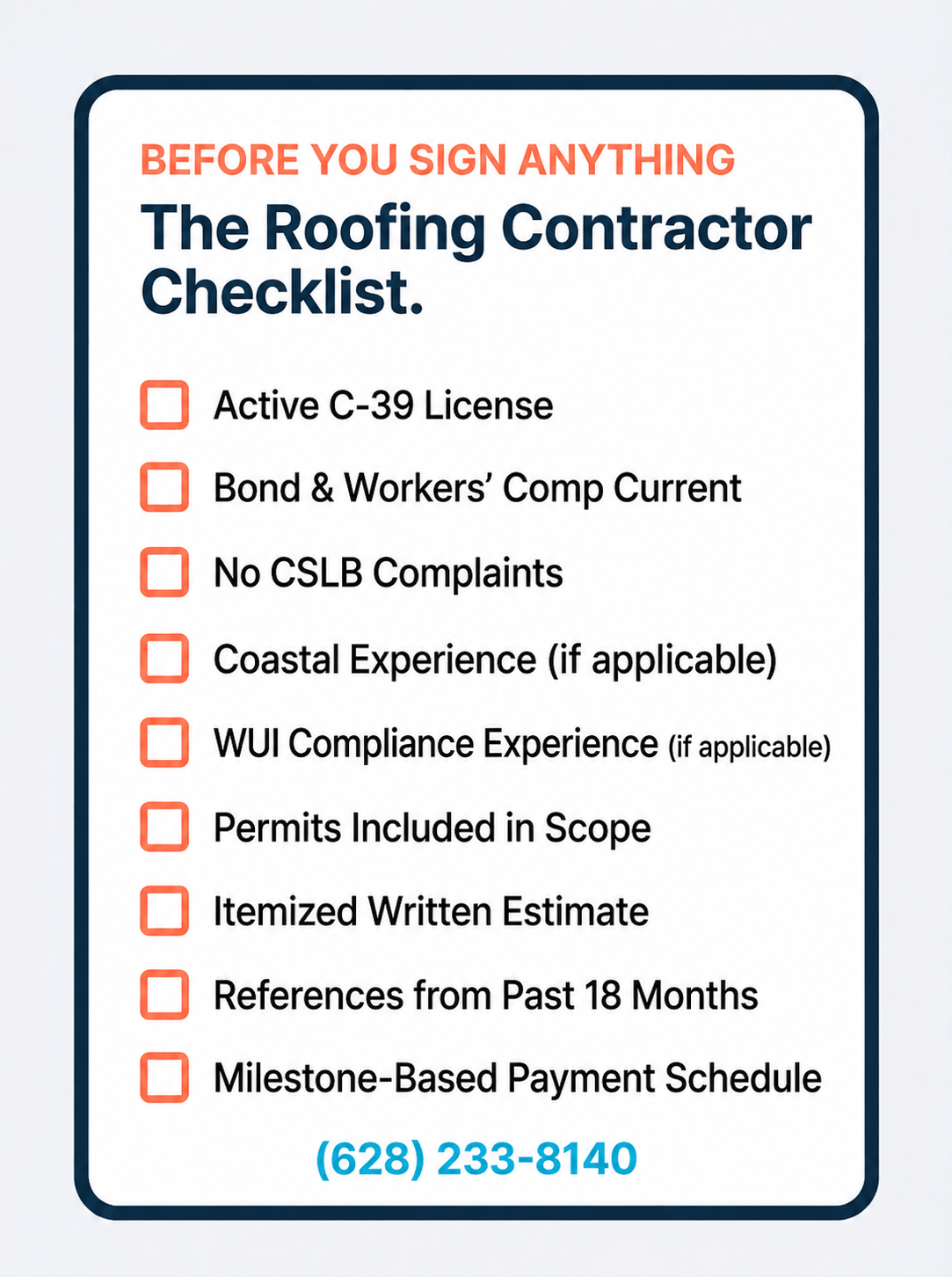
Ten-point roofing contractor evaluation checklist including C-39 licensing, WUI compliance experience, itemized estimates, and milestone-based payment schedules for Bay Area homeowners

Summary: The Contractor Evaluation Checklist

Before signing a roofing contract in the San Francisco Bay Area, confirm the following:

  • [ ] Active C-39 license verified on CSLB.ca.gov
  • [ ] Active bond and workers’ compensation insurance (not just general liability)
  • [ ] No material complaints on CSLB record
  • [ ] GAF Master Elite or Owens Corning Preferred status (if applicable to your material choice)
  • [ ] Documented experience with coastal moisture conditions (if applicable)
  • [ ] Documented experience with WUI compliance (if your parcel is in a WUI zone)
  • [ ] Permits and inspections explicitly included in the scope
  • [ ] Itemized, written estimate with material specs and warranty terms
  • [ ] References from comparable projects in the past 18 months
  • [ ] Payment schedule tied to milestones, not front-loaded

A contractor who clears all of these is qualified to work on your home. One who bristles at any of these questions is telling you something important.

Views: 5

Search ideas & guides for your remodel

Sign up for our newsletter

Subscribe to receive the latest blog posts to your inbox every week.

Newsletter

Consent

By subscribing you agree to with our Privacy Policy.

Recent Posts

  • All Posts
  • Commercial Roofing
  • Home Restoration
  • Roof Inspection
  • Roof Installation
  • Roof Repair
  • Roof Replacement
Aerial view of a hillside home with a dark asphalt shingle roof, solar panels, and wood decks surrounded by trees.

Insurance and Roof Claims Guide

Five-step infographic for choosing a roofing contractor in Marin County: verify the license, confirm insurance, check local experience, compare itemized estimates, and review ratings and warranty terms.

How to Choose a Roofing Contractor in Marin County

Infographic of a Marin County home mid-reroof beside the five roofing permit steps: confirm jurisdiction, submit application, plan review, roof work, and final inspection, with possible coastal, septic, and energy code reviews.

Roofing Permits in Marin County: What Homeowners Need to Know

Attic cross-section showing cool air entering soffit vents, passing through baffles over insulation, and warm air exiting a ridge vent.

Roof Ventilation & Attic Guide

Comparison chart of TPO, EPDM, and asphalt shingle roofing showing lifespan, energy reflectivity, and cost differences for flat vs. sloped roofs.

TPO & Flat Roofs in the Bay Area: Cost, Lifespan, and Repair vs. Replace

Map diagram showing an atmospheric river moisture band traveling from the tropical Pacific Ocean to the San Francisco Bay Area coastline.

How Atmospheric Rivers Damage Bay Area Roofs — What Homeowners Should Watch For

Diagram showing how Marin's marine layer fog causes granule loss, algae growth, and trapped attic moisture that shorten asphalt shingle roof life from 25–30 years to 10–15 years.

Why Asphalt Shingle Roofs Fail Early in Marin’s Marine-Layer Climate

Three-stage roof repair process diagram showing emergency repair, temporary repair, and permanent repair for Marin County roof leaks.

Roof Leak Triage in Marin: Emergency vs. Temporary vs. Permanent Repair

Hero infographic comparing overlay versus full tear-off roof replacement, showing shingle layers, deck inspection status, and cost differences.

The Re-Roofing Process: What to Expect, Overlay vs. Tear-Off

Share this post
  • Roof Installation
Picture of Michael Machkovsky
Michael Machkovsky
Michael serves as CEO at Marina Bay Roofing and brings seven years of hands-on roofing and construction experience to the team. Born and raised in the Bay Area, he’s dedicated to helping homeowners feel confident in the work protecting their homes. When he’s not on the job, you’ll find him spending time with his 7-year-old son.

Blog

Related posts

Lorem ipsum dolor sit amet, consectetur adipiscing elit.

Aerial view of a hillside home with a dark asphalt shingle roof, solar panels, and wood decks surrounded by trees.
Roof Inspection
Michael Machkovsky

Insurance and Roof Claims Guide

Filing a roof insurance claim is one of the most

Read More »
October 27, 2026
Five-step infographic for choosing a roofing contractor in Marin County: verify the license, confirm insurance, check local experience, compare itemized estimates, and review ratings and warranty terms.
Roof Installation
Michael Machkovsky

How to Choose a Roofing Contractor in Marin County

Marin County homeowners eventually face the same question: how do

Read More »
October 26, 2026
Infographic of a Marin County home mid-reroof beside the five roofing permit steps: confirm jurisdiction, submit application, plan review, roof work, and final inspection, with possible coastal, septic, and energy code reviews.
Roof Installation
Michael Machkovsky

Roofing Permits in Marin County: What Homeowners Need to Know

Getting a permit in Marin County follows a process that

Read More »
October 26, 2026
View All

Sign up for our newsletter

Join Our Community for Updates and roof renovation Insights

Newsletter

Consent

Ready to imagine your own project?

Request Your Personalized Consultation

and let’s talk about your space, your ideas, and how we can bring them to life.

Quick links
  • Home
  • About
  • Roofing Services
  • Commercial Roofing
  • Materials
  • Gallery
  • FAQ
  • Blog
  • contact
Services
  • Roof Inspection
  • Roof Installation
  • Roof Repair
  • Roof Replacement
  • Skylight Installation
Contact Us

Locations:
4411 Geary Blvd #301
San Francisco, CA 94118
Phone: (628) 233-8140

710 C Street Suite 208
San Rafael, CA 94901
Phone: (415) 860-7257

Email: [email protected]

License & Certifications

State Contractor License #1133789

Fully Licensed • Bonded • Insured

Find Us on Map

Proudly serving our community with honesty, craftsmanship, and care.

© 2026Marina Bay Roofing Inc.

Privacy Policy

Terms of Service

Facebook-f Yelp Instagram