Skip to content

Get an Instant Roof Cost Estimate →

Need a new roof or repairs?

  • Call (628) 233-8140
  • Home
  • About
    • Who We Are
    • Why Choose Us?
  • Roofing Services
    • Roof Inspection
    • Roof Installation
    • Roof Repair
    • Roof Replacement
    • Skylight Installation
  • Commercial
    • Commercial Roofing Contractors
    • Commercial Roof Installation
    • Commercial Roof Repairs
  • Materials
    • Asphalt Shingles
    • Metal Roof Panels
    • Clay & Concrete Tiles
    • Skylight Installation
    • TPO Flat Roof
    • Flat Roof Contractors
    • Flat Roof Repair
    • Flat Roof Installers
  • Service Area

    San Francisco Bay Area

    • Alamo
    • Belmont
    • Berkeley
    • Burlingame
    • Danville
    • Dublin
    • Fremont
    • Los Gatos
    • Millbrae
    • Milpitas
    • Oakland
    • Orinda
    • Palo Alto
    • Piedmont
    • Pleasanton
    • Pleasant Hill
    • Redwood City
    • Richmond
    • San Bruno
    • San Carlos
    • San Francisco
    • San Jose
    • San Leandro
    • San Lorenzo
    • San Mateo
    • San Pablo
    • San Ramon
    • South San Francisco
    • Walnut Creek

    Marin County

    • Belvedere
    • Corte Madera
    • Fairfax
    • Kentfield
    • Larkspur
    • Mill Valley
    • Novato
    • Ross
    • San Anselmo
    • San Rafael
    • Sausalito
    • Tiburon
    • Tamalpais-Homestead Valley
  • Roof Cost Calculator
  • Gallery
  • FAQs
  • Blog
Contact
  • Roof Installation

Marin County vs. San Francisco Roofing: What’s Different and Why It Matters

Michael Machkovsky

  • Roof Installation
Minimalist featured image on a deep navy background showing a flat-vector Golden Gate Bridge silhouette spanning the center, with a coral-orange hillside roofline and ember icon on the Marin County side and a cyan Victorian roofline with a preservation shield icon on the San Francisco side, overlaid with the title "Marin County vs. San Francisco Roofing: What's Different and Why It Matters."

Homeowners searching for a Marin County roofer or comparing San Francisco roofing companies often assume the same contractor can approach both markets the same way. That assumption leads to problems — missed permits, rejected inspections, and code violations that surface at resale. The roofing fundamentals are the same on both sides of the Golden Gate. The regulatory and environmental frameworks are not.

This guide breaks down the key differences between roofing in Marin County and roofing in San Francisco — specifically the two factors that most commonly trip up contractors and homeowners alike: Wildland-Urban Interface fire compliance in Marin, and historic preservation requirements in San Francisco.

DIRECT ANSWER:

Marin County roofing is primarily governed by WUI (Wildland-Urban Interface) fire codes that dictate materials, assembly, and ventilation. San Francisco roofing is governed by the SF Building Code, which adds layers of historic preservation and design review requirements in designated districts. Both require permits. Neither is optional.

Quick Answers to FAQs

Does every home in Marin County require WUI-compliant roofing?

No. WUI requirements apply to parcels within designated State Responsibility Areas and local High Fire Hazard Severity Zones. Flat-lot homes in central Novato or San Rafael city proper may not carry WUI classification, while hillside properties in the same zip code do. The classification is determined at the parcel level, and a permit application for re-roofing in Marin County will trigger a review of the parcel’s classification status. A qualified marin county roofer should confirm this before finalizing material specifications.

Do all San Francisco roof replacements require historic review?

Not all. Properties outside designated historic districts — including newer construction in areas like the Bayview, Visitacion Valley, or parts of the Excelsior — proceed through standard DBI permit review without Planning Department involvement. The historic review layer applies specifically to properties identified as contributors in Article 10 or Article 11 districts, or individually designated landmarks. Your contractor should identify your property’s status as part of the permit preparation process.

Can the same contractor work in both Marin County and San Francisco?

Yes — but they should demonstrate competency in both regulatory environments, not just technical roofing skill. The WUI compliance requirements specific to Marin County and the historic preservation process specific to San Francisco are distinct knowledge sets. Contractors who operate across both markets should be able to speak specifically to each — permit timelines, material approval processes, and inspection requirements — without conflating them.

What questions should I ask before hiring a roofer for a Marin County home in a WUI zone?

Ask the contractor to identify the specific WUI-compliant assembly they intend to use — product, underlayment, and vent specification — and confirm they have pulled and passed final inspection on WUI-classified projects in Marin County. Ask for the permit number on a recent project if you want to verify. A contractor with genuine WUI experience will answer these questions directly.

The Regulatory Split: WUI vs. Historic Preservation

This is the core distinction that separates roofing in Marin County from roofing in San Francisco, and it shapes everything from the materials you can use to how long the permit process takes.
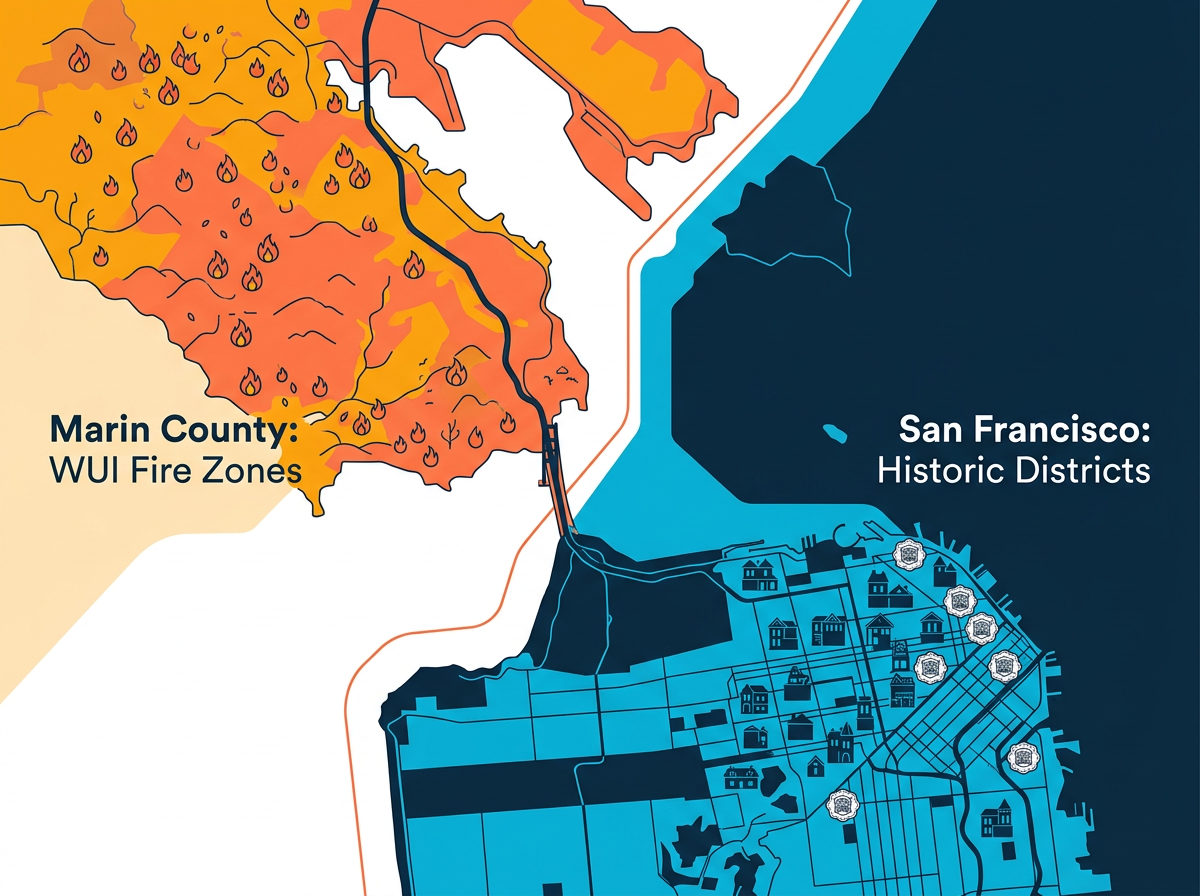
Stylized flat-vector map illustration of the San Francisco Bay Area divided at the Golden Gate, showing Marin County in warm amber tones with wildland fire zone and ember icons on the left, and San Francisco in navy and cyan tones with Victorian rooftop silhouettes and historic preservation badge icons on the right.

Marin County: Wildland-Urban Interface Fire Compliance

Large portions of Marin County sit within designated WUI (Wildland-Urban Interface) zones — areas where developed residential neighborhoods directly adjoin wild, fire-prone land. Mill Valley, Fairfax, San Anselmo, Ross, and hillside neighborhoods in Tiburon and Corte Madera all carry WUI classification designations that directly affect roofing requirements.

Under California Building Code Chapter 7A (Materials and Construction Methods for Exterior Wildfire Exposure), homes in these zones must meet significantly elevated standards. A marin county roofer working in WUI territory isn’t just selecting a roofing product — they’re selecting a tested assembly that must meet ember resistance, fire spread, and radiant heat standards as a complete system.

•        Class A fire-rated roofing assembly required throughout most WUI-classified areas in Marin

•        Roof ventilation openings must include ember-resistant mesh (1/16″ maximum opening) under California WUI code

•        Combustible eave assemblies are prohibited in some WUI designations — soffit materials, fascia, and trim must also meet ignition-resistant standards

•        Marin County Fire Department and Cal Fire both maintain jurisdiction over WUI zones, creating a dual-authority compliance environment

•        Roof-to-wall junctions require specific detailing to prevent ember intrusion — standard installation practices are insufficient

The practical consequence: a standard 30-year architectural shingle that’s legal and appropriate on a flat-lot neighborhood in Novato may not satisfy the WUI-specific assembly requirements for a hillside home in Fairfax or Mill Valley. Material selection, underlayment specification, and installation detailing must all be evaluated against WUI requirements before a project begins.

CBC Chapter 7A  —  California Building Code chapter governing exterior wildfire exposure, mandatory in WUI-classified Marin neighborhoods.

Class A Assembly  —  Minimum fire-resistance rating required in Marin County WUI zones — evaluated on the complete system, not just the surface product.

San Francisco: Historic Preservation and Design Review

San Francisco’s roofing environment is shaped by an entirely different set of constraints. The city contains one of the largest concentrations of Victorians, Edwardians, and early-twentieth-century vernacular architecture in the United States. Significant portions of the city — including much of the Western Addition, Haight-Ashbury, the Castro, Noe Valley, and large sections of the Sunset and Richmond districts — fall within Article 10 or Article 11 historic districts under the San Francisco Planning Code.

In these areas, roofing projects that are visible from the public right-of-way may trigger Preservation Review, Categorical Exemption determination, or a Section 106 consultation depending on the property’s status. San Francisco roofing companies working in historic districts must be familiar with the Planning Department’s process, not just the Building Department’s permit requirements.

•        Roof replacement on a contributing building in an Article 10 district requires a Certificate of Appropriateness from the Historic Preservation Commission

•        Synthetic materials that replicate historic profiles (slate-look composition, wood-shake profiles) may be approvable — but require documentation and often a DBI-HPD joint review

•        TPO and modified bitumen flat roofing on Edwardians or Victorians typically requires documentation that the change doesn’t affect character-defining features

•        Solar installations on historic rooflines in SF face additional review layers not present in Marin County projects

•        Permit timelines in SF historic districts routinely run 6–12 weeks longer than standard residential projects

The key distinction: San Francisco’s design review process evaluates what a roof looks like from the street, not just whether it meets structural and fire safety standards. Material swaps that are routine in Marin — switching from wood shake to composition, for example — can require documentation, approval, and hearing time in an SF historic district.

Side-by-Side: How the Two Markets Compare

Factor Marin County Roofing San Francisco Roofing
Primary regulatory driver WUI fire compliance (CBC 7A, Cal Fire zone classification) SF Building Code + Historic Preservation (Planning Code Articles 10/11)
Fire rating requirement Class A assembly mandatory in WUI zones; ember-resistant venting required Class A surface required citywide; assembly standards vary by roof type
Material flexibility WUI-approved assemblies only in designated zones; not all Class A products qualify Material choice may require historic compatibility review in designated districts
Permit authority Marin County CDD + local city Building Dept; Cal Fire for WUI overlay SF DBI for building permit; SF Planning Dept for historic review where applicable
Typical permit timeline 2–6 weeks for standard residential re-roof; longer in WUI with Cal Fire review 3–8 weeks standard; 8–16+ weeks in Article 10 historic districts
Climate exposure Marine layer, fog, seasonal wildfire ember fall, coastal moisture Dense coastal fog, salt air, wind-driven moisture on western slope exposures
Primary material concern Ember resistance, ignition-resistant assemblies, valley and vent detailing Historic profile compatibility, flat-roof drainage, wind uplift on exposed ridges
Common complications WUI zone classification surprises; undersized ember guards on older homes Certificate of Appropriateness delays; unapproved material swaps on historic stock

The Climate Factor: What Marin and SF Share

Despite the regulatory differences, both markets share a climate environment that creates specific performance demands on any roofing system. The marine layer that blankets both Marin County and San Francisco for much of the spring and summer drives sustained moisture exposure — not heavy rain events, but persistent condensation, morning fog, and low-humidity cycling that gradually degrades sealants, flashing, and penetration details over time.

For a marin county roofer, this means proper ventilation is not optional. Inadequate attic ventilation in the Bay Area’s high-moisture coastal environment accelerates sheathing deterioration from below, even when the roofing surface itself is intact. For San Francisco, west-facing slopes on the Sunset and Richmond districts experience some of the most sustained wind-driven moisture exposure in the Bay Area — a detail that makes proper flashing specification and fastening patterns more consequential than they would be in an inland market.

WHAT THIS MEANS FOR HOMEOWNERS

When evaluating roofing contractors in either market, ask directly whether they are familiar with WUI compliance (if you’re in Marin) or with San Francisco’s historic preservation review process (if you’re in the city). A contractor who cannot speak fluently to the regulatory environment specific to your location is likely to create permit delays or compliance issues that cost you more than the project itself.

Why Roofing Marin County Requires WUI Expertise, Not Just Fire Resistance

There is a common misunderstanding among homeowners — and some contractors — that using a Class A-rated shingle satisfies WUI requirements. It does not. WUI compliance under CBC Chapter 7A evaluates the complete roofing assembly: surface product, underlayment, deck protection, ridge and hip detailing, valley treatment, and ventilation openings. A product that carries a Class A rating in isolation may fail the assembly test when combined with incompatible underlayment or non-compliant vent components.
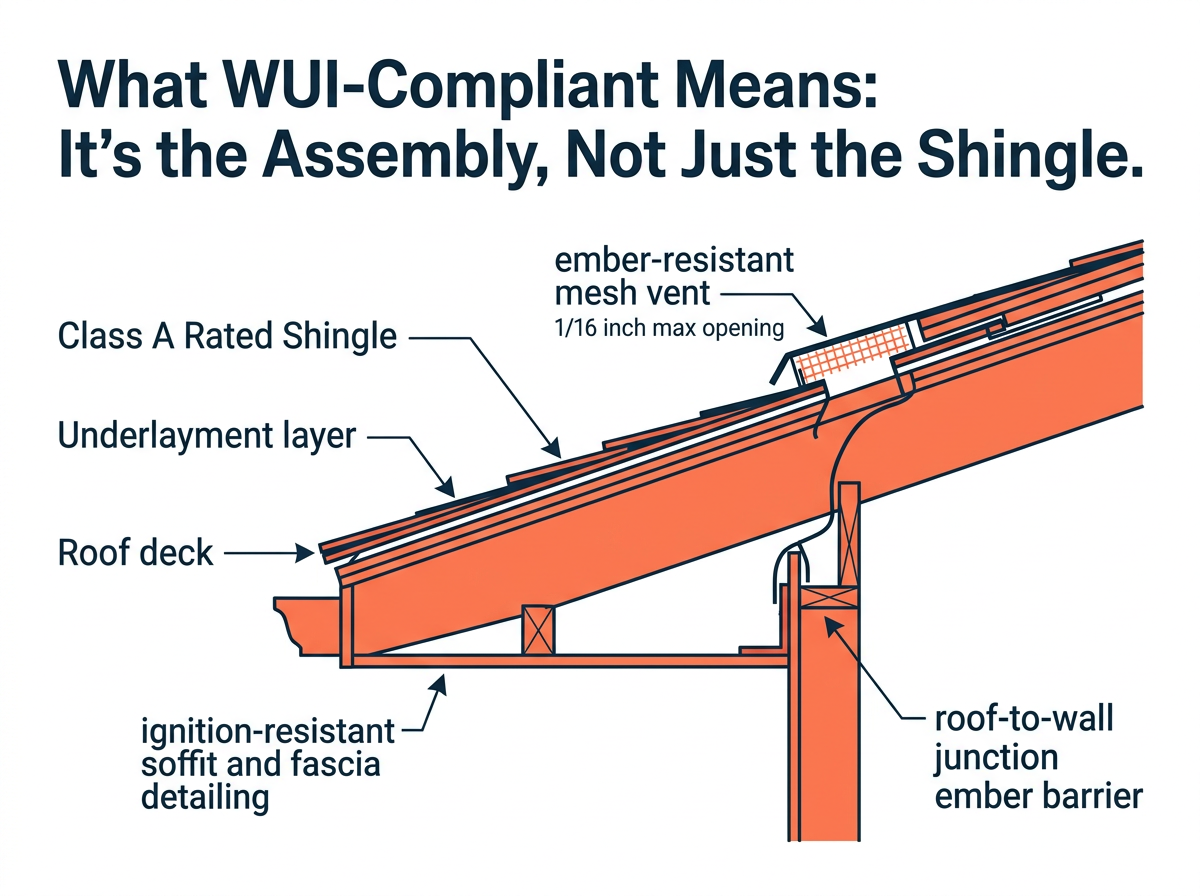
Cross-section diagram of a WUI-compliant Class A roofing assembly showing surface layer, underlayment, deck, ember-resistant venting, and roof-to-wall junction detailing required in Marin County fire zones.

In Marin County, this matters in practical terms at two points: permit issuance and final inspection. A Marin County building inspector reviewing a re-roof in a WUI zone will verify assembly compliance — not just the product specification on the permit application. Contractors who lack direct experience with WUI assembly requirements often discover the gap at the inspection stage, after the roof is installed.

The relevant Marin County cities for WUI classification include significant portions of Mill Valley, Fairfax, San Anselmo, Ross, Kentfield, Corte Madera hillside areas, and parts of Novato and San Rafael adjacent to open space. The classification applies to the parcel, not the street — properties on the same block can carry different WUI designations depending on proximity to wildland vegetation.

Why Roofing in San Francisco Requires Design Fluency, Not Just Technical Skill

San Francisco’s housing stock is among the most architecturally protected in the United States. For San Francisco roofing companies, this creates a work environment where the technical quality of the installation is only part of the deliverable. The process — permit documentation, material specification, design review where required — is equally consequential to a project’s outcome.

Homeowners in SF historic districts who replace a roof with an unapproved material substitution — wood shake to composition shingle, for example, on a contributing Victorian — can face Planning Department enforcement action that requires documentation, correction, and in some cases a Discretionary Review process before the permit is closed. This is not a theoretical risk. It is a documented pattern in SF Building Department records, and it creates title and resale complications that persist beyond the original project.

The practical guidance for SF homeowners: before any re-roof project, confirm the property’s historic designation status (contributing vs. non-contributing, Article 10 vs. Article 11 district), identify what review is required, and verify that the roofing contractor has submitted and managed permits in SF historic districts before. The process is manageable with an experienced contractor. Without one, it creates avoidable delays and expense.

Schedule a Roofing Consultation in Marin County

Marina Bay Roofing specializes in WUI-compliant roofing systems across Marin County — San Rafael, Mill Valley, Novato, Fairfax, Corte Madera, and beyond. We know the local codes, the permit process, and the assembly requirements your project demands.

Call (628) 233-8140

Views: 5

Search ideas & guides for your remodel

Sign up for our newsletter

Subscribe to receive the latest blog posts to your inbox every week.

Newsletter

Consent

By subscribing you agree to with our Privacy Policy.

Recent Posts

  • All Posts
  • Commercial Roofing
  • Home Restoration
  • Roof Inspection
  • Roof Installation
  • Roof Repair
  • Roof Replacement
Aerial view of a hillside home with a dark asphalt shingle roof, solar panels, and wood decks surrounded by trees.

Insurance and Roof Claims Guide

Five-step infographic for choosing a roofing contractor in Marin County: verify the license, confirm insurance, check local experience, compare itemized estimates, and review ratings and warranty terms.

How to Choose a Roofing Contractor in Marin County

Infographic of a Marin County home mid-reroof beside the five roofing permit steps: confirm jurisdiction, submit application, plan review, roof work, and final inspection, with possible coastal, septic, and energy code reviews.

Roofing Permits in Marin County: What Homeowners Need to Know

Attic cross-section showing cool air entering soffit vents, passing through baffles over insulation, and warm air exiting a ridge vent.

Roof Ventilation & Attic Guide

Comparison chart of TPO, EPDM, and asphalt shingle roofing showing lifespan, energy reflectivity, and cost differences for flat vs. sloped roofs.

TPO & Flat Roofs in the Bay Area: Cost, Lifespan, and Repair vs. Replace

Map diagram showing an atmospheric river moisture band traveling from the tropical Pacific Ocean to the San Francisco Bay Area coastline.

How Atmospheric Rivers Damage Bay Area Roofs — What Homeowners Should Watch For

Diagram showing how Marin's marine layer fog causes granule loss, algae growth, and trapped attic moisture that shorten asphalt shingle roof life from 25–30 years to 10–15 years.

Why Asphalt Shingle Roofs Fail Early in Marin’s Marine-Layer Climate

Three-stage roof repair process diagram showing emergency repair, temporary repair, and permanent repair for Marin County roof leaks.

Roof Leak Triage in Marin: Emergency vs. Temporary vs. Permanent Repair

Hero infographic comparing overlay versus full tear-off roof replacement, showing shingle layers, deck inspection status, and cost differences.

The Re-Roofing Process: What to Expect, Overlay vs. Tear-Off

Share this post
  • Roof Installation
Picture of Michael Machkovsky
Michael Machkovsky
Michael serves as CEO at Marina Bay Roofing and brings seven years of hands-on roofing and construction experience to the team. Born and raised in the Bay Area, he’s dedicated to helping homeowners feel confident in the work protecting their homes. When he’s not on the job, you’ll find him spending time with his 7-year-old son.

Blog

Related posts

Lorem ipsum dolor sit amet, consectetur adipiscing elit.

Aerial view of a hillside home with a dark asphalt shingle roof, solar panels, and wood decks surrounded by trees.
Roof Inspection
Michael Machkovsky

Insurance and Roof Claims Guide

Filing a roof insurance claim is one of the most

Read More »
October 27, 2026
Five-step infographic for choosing a roofing contractor in Marin County: verify the license, confirm insurance, check local experience, compare itemized estimates, and review ratings and warranty terms.
Roof Installation
Michael Machkovsky

How to Choose a Roofing Contractor in Marin County

Marin County homeowners eventually face the same question: how do

Read More »
October 26, 2026
Infographic of a Marin County home mid-reroof beside the five roofing permit steps: confirm jurisdiction, submit application, plan review, roof work, and final inspection, with possible coastal, septic, and energy code reviews.
Roof Installation
Michael Machkovsky

Roofing Permits in Marin County: What Homeowners Need to Know

Getting a permit in Marin County follows a process that

Read More »
October 26, 2026
View All

Sign up for our newsletter

Join Our Community for Updates and roof renovation Insights

Newsletter

Consent

Ready to imagine your own project?

Request Your Personalized Consultation

and let’s talk about your space, your ideas, and how we can bring them to life.

Quick links
  • Home
  • About
  • Roofing Services
  • Commercial Roofing
  • Materials
  • Gallery
  • FAQ
  • Blog
  • contact
Services
  • Roof Inspection
  • Roof Installation
  • Roof Repair
  • Roof Replacement
  • Skylight Installation
Contact Us

Locations:
4411 Geary Blvd #301
San Francisco, CA 94118
Phone: (628) 233-8140

710 C Street Suite 208
San Rafael, CA 94901
Phone: (415) 860-7257

Email: [email protected]

License & Certifications

State Contractor License #1133789

Fully Licensed • Bonded • Insured

Find Us on Map

Proudly serving our community with honesty, craftsmanship, and care.

© 2026Marina Bay Roofing Inc.

Privacy Policy

Terms of Service

Facebook-f Yelp Instagram